
What's Happening?
Researchers at Drexel University have made a groundbreaking discovery that challenges the traditional understanding of fluid mechanics. In a study published in Physical Review Letters, the team demonstrated that under certain conditions, a simple liquid
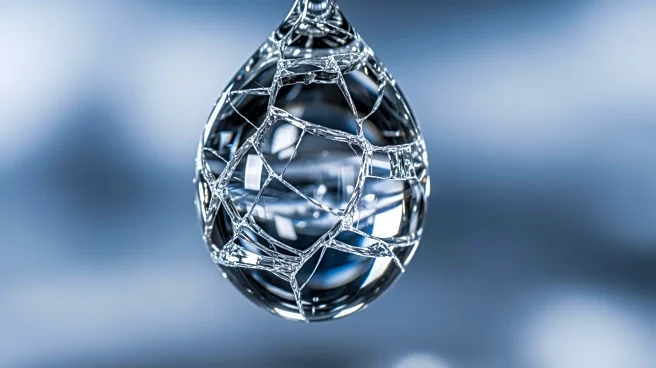
can behave like a solid and fracture. This phenomenon was observed during an extensional rheology test, where viscous liquids, when stretched with enough force, snapped abruptly instead of flowing. The research, led by Thamires Lima, PhD, and Nicolas Alvarez, PhD, revealed that viscosity plays a significant role in this behavior, suggesting that many simple liquids might share a similar breaking point. The study involved testing tar-like hydrocarbon blends and styrene oligomer, both of which fractured at a critical stress of 2 megaPascals. This discovery opens new avenues for controlling liquids in various applications, including hydraulics and 3D printing.
Why It's Important?
This discovery has significant implications for industries that rely on fluid dynamics, such as manufacturing, healthcare, and engineering. Understanding that simple liquids can fracture like solids under certain conditions could lead to innovations in how liquids are handled and processed. For instance, this knowledge could improve the efficiency of fiber spinning and other applications that use viscous liquids. Additionally, the finding challenges long-held assumptions about the behavior of liquids, potentially leading to new research and technological advancements. The ability to predict and control the fracture of liquids could also impact the design of materials and systems that rely on liquid flow, offering new solutions to existing challenges.
What's Next?
The research team plans to further investigate the underlying mechanisms of this phenomenon, particularly the role of cavitation, where vapor bubbles form and collapse within the liquid. Understanding why and how this behavior occurs in other liquids is a priority for future studies. The findings may also prompt other researchers to explore similar behaviors in different types of liquids, potentially leading to broader applications and innovations. As the scientific community delves deeper into this area, new questions and opportunities for exploration are likely to emerge, potentially transforming the field of fluid dynamics.