




What's Happening?
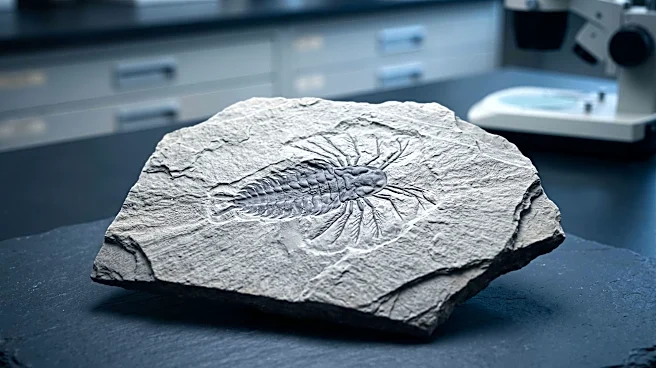
Paleontologists have unearthed a 520-million-year-old fossilized larva from the Cambrian period, remarkably preserving its internal organs, including a brain and digestive tract. This discovery challenges previous assumptions about the fossilization of
soft-bodied organisms, as such delicate tissues typically decompose before mineralization can occur. Lead researcher Martin Smith expressed surprise at the level of detail maintained over half a billion years. The specimen, an ancient ancestor of arthropods like insects, crabs, and lobsters, offers a rare glimpse into the early organization of life during the Cambrian Explosion. Advanced imaging technology, specifically synchrotron X-ray tomography, was used to create 3D reconstructions of the larva, revealing a preserved brain, digestive glands, a primitive circulatory system, and nerve fibers connected to its limbs and eyes. Co-author Katherine Dobson highlighted the almost perfect preservation achieved through natural fossilization.
Why It's Important?
This extraordinary fossil significantly advances the understanding of early animal development and the evolutionary history of arthropods. The preservation of complex internal structures, particularly the brain, indicates that early arthropods possessed a higher degree of anatomical complexity than previously believed. By identifying specific brain structures, such as the protocerebrum, researchers can draw a direct evolutionary line to modern arthropod heads. This critical brain region is thought to have been instrumental in the success of arthropods, enabling sensory integration necessary for their adaptation to diverse ecosystems globally. The finding provides a vital key to unlocking the developmental timeline of one of the most successful animal phyla in Earth's history, offering insights into how life diversified and evolved during the pivotal Cambrian period.
What's Next?
The detailed analysis of this fossil, published in the journal Nature, is expected to prompt further research into the conditions and mechanisms that allowed for such exceptional preservation of soft tissues. Scientists may now re-evaluate other fossil sites for similar, previously overlooked specimens, potentially leading to more discoveries that could refine the understanding of early life forms. The insights gained from this larva's anatomy will likely inform new models of arthropod evolution and development, influencing future paleontological studies. Researchers will continue to use advanced imaging techniques to explore other ancient fossils, hoping to uncover more hidden complexities of prehistoric organisms and further bridge gaps in the fossil record.
Beyond the Headlines
The discovery of this remarkably preserved larva raises profound questions about the rarity of such fossilization events and the potential for other soft-bodied organisms to be preserved under specific, yet unknown, conditions. It underscores the limitations of traditional fossil records, which predominantly capture hard-bodied organisms, and highlights the vast amount of biological information that may still be hidden within ancient rocks. This finding could inspire new theories on taphonomy—the study of how organisms decay and become fossilized—and encourage interdisciplinary approaches combining paleontology with advanced imaging and molecular biology. The existence of such complex internal structures in early arthropods also deepens the mystery of the Cambrian Explosion, suggesting that the rapid diversification of life during this period involved organisms that were already more sophisticated than previously imagined, pushing the boundaries of evolutionary timelines.