
What's Happening?
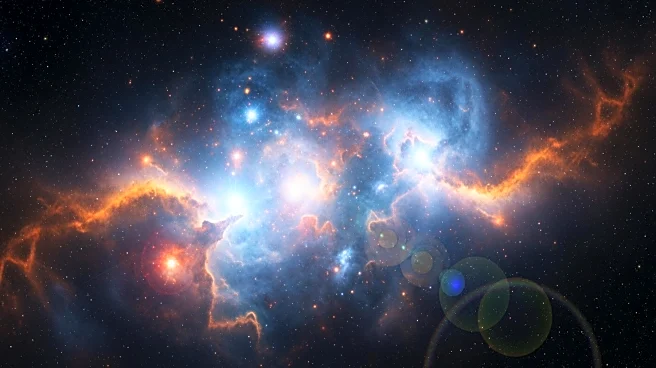
NASA's James Webb Space Telescope and Chandra X-ray Observatory have captured a stunning image of Pismis 24, a young star cluster located in the Lobster Nebula, approximately 5,500 light-years from Earth.
The image, taken on December 22, 2025, showcases a vibrant stellar nursery, providing insights into the properties and evolution of massive stars. The Webb telescope's infrared capabilities highlight the cluster's intricate details, while Chandra's X-ray data adds bursts of colored lights, indicating high-energy activity from active stars. This collaboration between the two telescopes offers a rare glimpse into one of the closest sites of massive star birth, enhancing our understanding of stellar formation and evolution.
Why It's Important?
The observations of Pismis 24 by NASA's telescopes are significant for astrophysics, as they offer valuable data on the formation and lifecycle of massive stars. Understanding these processes is crucial for comprehending the broader dynamics of galaxies and the universe. The insights gained from such studies can inform models of stellar evolution and contribute to our knowledge of cosmic phenomena. Additionally, the collaboration between the James Webb Space Telescope and Chandra X-ray Observatory exemplifies the synergy between different observational technologies, enhancing the depth and breadth of astronomical research.