
What's Happening?
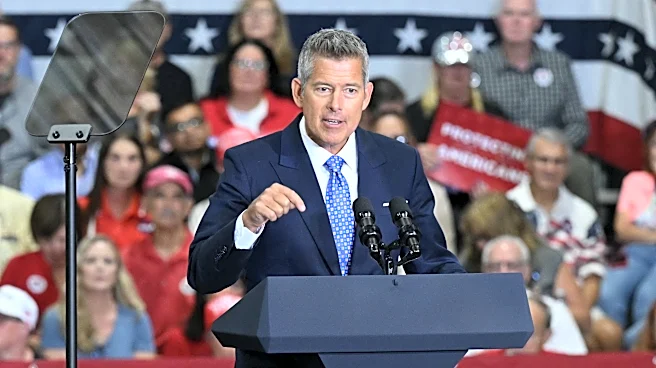
Transportation Secretary Sean Duffy expressed his dislike for car stop/start buttons, crediting Lee Zeldin for their removal in new car models. Duffy made these comments during a Detroit appearance with
DHS Secretary Markwayne Mullin, where they celebrated the closure of over 100 truck driving schools. In response, Congressman Sean Casten humorously tweeted, quoting Duffy in a satirical manner: “First they came for hand cranks, and I said nothing. Then they integrated starter/alternators and I said nothing. Then they put remote start on keyfobs and I said nothing.” This tweet implies a progression of technological changes in cars that Duffy might similarly dislike, highlighting the perceived triviality of his complaint about stop/start buttons.
Why It's Important?
This exchange, while seemingly lighthearted, highlights a broader cultural and political divide regarding technological advancements and consumer preferences. Secretary Duffy's public statement, and Congressman Casten's satirical response, reflect differing perspectives on modern conveniences in everyday life. For some, the removal of features like stop/start buttons might be seen as a return to simpler, more preferred designs, while for others, it could be viewed as a step backward in automotive innovation. The context of Duffy's comments during an official event, alongside a celebration of closing truck driving schools, also subtly underscores how political figures can use seemingly minor issues to connect with certain segments of the public or to project a particular image. This interaction, though humorous, touches on the ongoing debate about the balance between tradition and progress in various sectors.
What's Next?
While this specific interaction is unlikely to lead to significant policy changes, it may contribute to ongoing public discourse about automotive technology and consumer choice. Automakers will continue to balance innovation with consumer demand, and public figures may continue to voice opinions on such matters. The humorous nature of Congressman Casten's response could also encourage more public engagement with political figures on social media, fostering a more informal and relatable dialogue. This type of commentary serves as a reminder that even seemingly minor technological preferences can become points of public discussion and political jest.
Beyond the Headlines
The humorous exchange between Congressman Casten and Secretary Duffy, while focused on car features, subtly reflects a broader societal tension between embracing technological progress and clinging to familiar, traditional methods. Secretary Duffy's 'pet peeve' about stop/start buttons, and his celebration of their removal, can be seen as a microcosm of resistance to change that often accompanies new innovations. Congressman Casten's satirical response, using a well-known historical quote structure, highlights the potential for such resistance to appear out of touch with the natural evolution of technology. This dynamic is present across various industries and aspects of daily life, where the adoption of new technologies often faces pushback from those who prefer older, established ways. It underscores how even seemingly trivial technological preferences can become symbolic of deeper cultural attitudes towards progress and modernity.