



What's Happening?
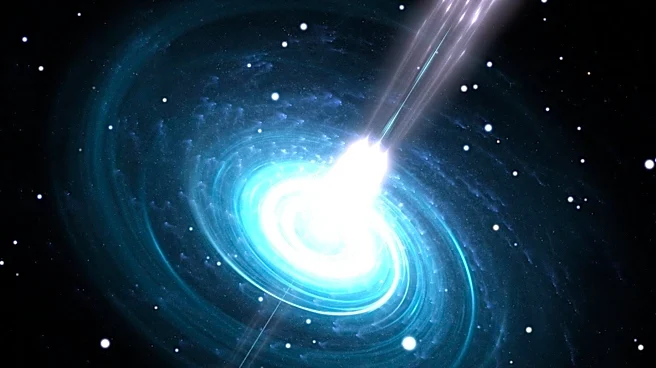
Astronomers have potentially confirmed the phenomenon of vacuum birefringence, a quantum effect predicted nearly 90 years ago, using observations of a magnetar. This rare type of neutron star, known for its extremely strong magnetic fields, was studied
by an international team led by Dr. Marcus Lower. The observations suggest that the magnetar's magnetic field is strong enough to cause light to refract in a way that aligns with the predictions of vacuum birefringence.
Why It's Important?
This discovery could provide a new way to study quantum mechanics in extreme environments, offering insights into the fundamental nature of the universe. Understanding vacuum birefringence could help bridge the gap between quantum mechanics and general relativity, two of the most important theories in physics. The findings also highlight the potential of magnetars as natural laboratories for studying quantum phenomena.
What's Next?
Further observations and improved simulations are needed to confirm the detection of vacuum birefringence and to explore its implications for quantum physics. Continued research on magnetars and their unique properties could lead to new breakthroughs in our understanding of the universe and the fundamental forces that govern it.