

What's Happening?
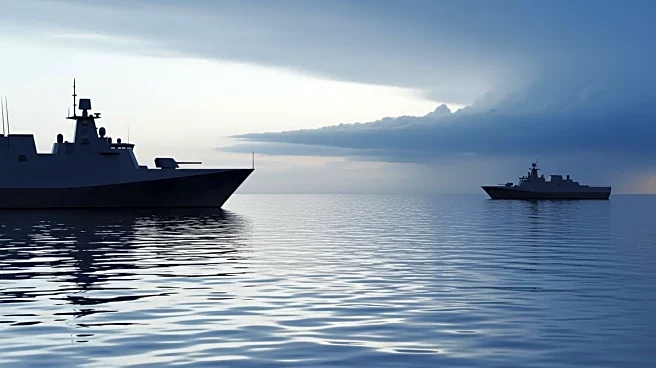
The Armed Forces of the Philippines have reported a second 'close encounter' this month with a Chinese naval vessel in the disputed South China Sea. The incident involved a Chinese warship, the 532 Missile Frigate, which came within five to eight meters
of the Philippine Navy's BRP Benguet. This proximity was described as 'extremely close' by Rear Admiral Roy Vicent Trinidad, who asserted that the maneuver was intentional and unsafe. The Philippine vessel was on a routine patrol near Pag-asa Island when the Chinese ship allegedly attempted to steer it off course. Despite the close call, no collision occurred due to the skilled seamanship of the Philippine crew. This incident follows another earlier in the month where a Chinese vessel aimed its fire control radar at a Philippine ship. The timing coincides with the Philippines signing a new military pact with France, aimed at enhancing bilateral cooperation through joint military training.
Why It's Important?
This development is significant as it highlights the ongoing tensions in the South China Sea, a region with strategic military and economic importance. The Philippines' labeling of the encounter as an 'escalation' underscores the fragile nature of regional security and the potential for conflict. The involvement of the Chinese Navy, as opposed to civilian vessels, marks a notable shift in the dynamics of these encounters, potentially indicating a more aggressive stance by China. The new military agreement between the Philippines and France could alter regional power balances, providing the Philippines with additional support and signaling to China that its actions are being closely monitored by international powers.
What's Next?
The Philippines is likely to continue its patrols in the disputed waters, potentially leading to further encounters. The new military pact with France may result in increased joint exercises, which could serve as a deterrent to further Chinese naval aggression. Regional stakeholders, including the United States and ASEAN countries, may respond by reinforcing their own military and diplomatic strategies in the area. The situation could prompt discussions at international forums, such as the United Nations, to address maritime security and freedom of navigation in the South China Sea.