









What's Happening?
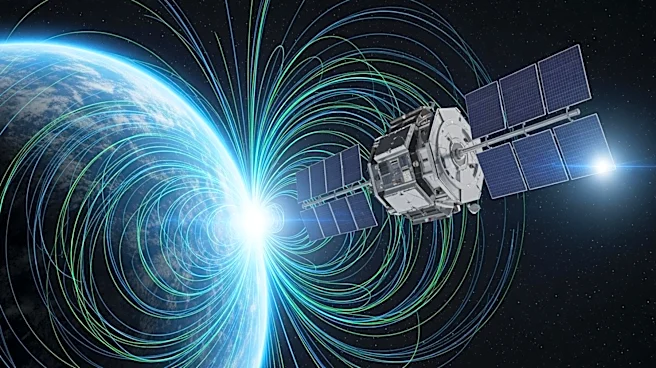
Europe and China have successfully launched the Smile spacecraft, a joint mission aimed at capturing the first global X-ray images of Earth's magnetosphere. The mission, which marks a significant collaboration between the European Space Agency (ESA) and the Chinese
Academy of Sciences, seeks to provide a comprehensive view of the magnetosphere, a protective magnetic field that deflects solar wind from Earth. Smile's instruments, including a Soft X-ray Imager and an Ultraviolet Imager, will observe the magnetosphere's structure and auroras, offering insights into how Earth's magnetic field protects the planet and when it fails.
Why It's Important?
The Smile mission represents a major advancement in understanding Earth's magnetosphere, which plays a crucial role in protecting the planet from harmful solar wind particles. By capturing detailed images of the magnetosphere, scientists can better understand its dynamics and the conditions under which it falters, potentially leading to geomagnetic storms that can disrupt power grids and communication systems. The collaboration between ESA and China highlights the importance of international cooperation in space exploration, providing valuable data that can enhance space weather forecasting and improve our understanding of Earth's magnetic environment.
What's Next?
Smile will spend the next month reaching its operational orbit, followed by instrument checkouts and data collection. Routine science operations are expected to begin in July, with the first images of the magnetosphere arriving three months after launch. The mission is planned to last three years, during which hundreds of scientists will analyze the data to improve our understanding of the magnetosphere. The collaboration between ESA and China may pave the way for future joint missions, although current geopolitical tensions could impact further cooperation.
Beyond the Headlines
The Smile mission arrives at a politically sensitive time, with Europe limiting scientific collaboration with China due to geopolitical concerns. Despite these challenges, the mission demonstrates the potential for science to bridge political divides and foster international cooperation. The data collected by Smile could revolutionize our understanding of the magnetosphere, replacing textbook diagrams with real images and enhancing our ability to predict space weather events.