


What's Happening?
Astronomers have successfully captured detailed images of thermonuclear explosions on the surfaces of two white dwarfs, providing new insights into the complexity of these nova eruptions. The observations were made using the Center for High Angular Resolution
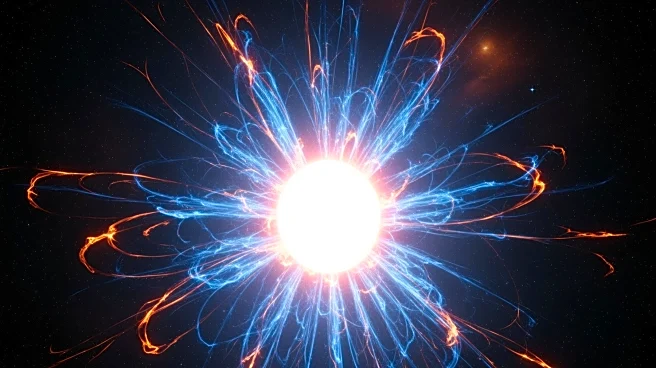
Astronomy (CHARA) array, which combines the light from six telescopes on Mount Wilson in California. The study focused on two nova events, V1674 Herculis and V1405 Cassiopeia, revealing that these eruptions are more intricate than previously understood. Unlike a Type 1a supernova, a nova does not destroy the white dwarf but occurs when it accumulates too much matter from a companion red giant star, leading to a thermonuclear detonation on its surface. The CHARA array's images showed that V1674 Herculis experienced one of the fastest nova eruptions on record, with bipolar outflows detected, while V1405 Cassiopeia had a slower eruption with delayed outflows.
Why It's Important?
This breakthrough in observing nova eruptions provides significant insights into the processes occurring on white dwarfs, which are crucial for understanding stellar evolution and the dynamics of binary star systems. The ability to capture detailed images of these events allows astronomers to connect the nuclear reactions on the star's surface with the geometry of the ejected material and the high-energy radiation detected from space. This knowledge could enhance our understanding of the life cycles of stars and the mechanisms behind stellar explosions, potentially impacting theories related to the formation of elements in the universe and the behavior of binary star systems.
What's Next?
Future research will likely focus on observing more nova events to further understand the variations in eruption dynamics and their implications for stellar physics. The data from these observations could lead to improved models of nova eruptions and their role in the broader context of galactic evolution. Additionally, continued advancements in telescope technology and observational techniques may allow for even more detailed studies of these and other astronomical phenomena.