






What's Happening?
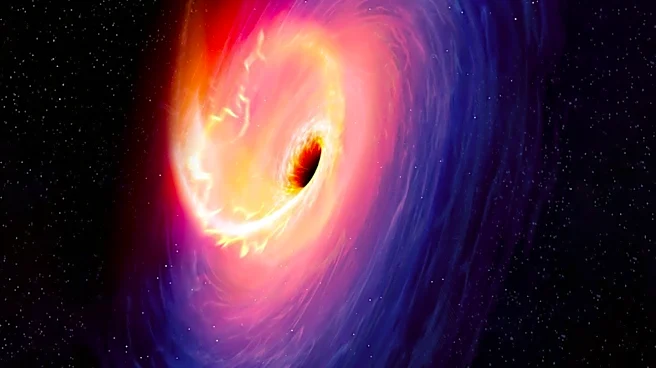
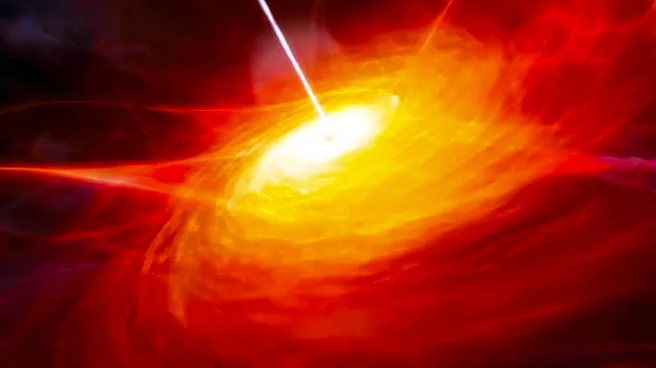
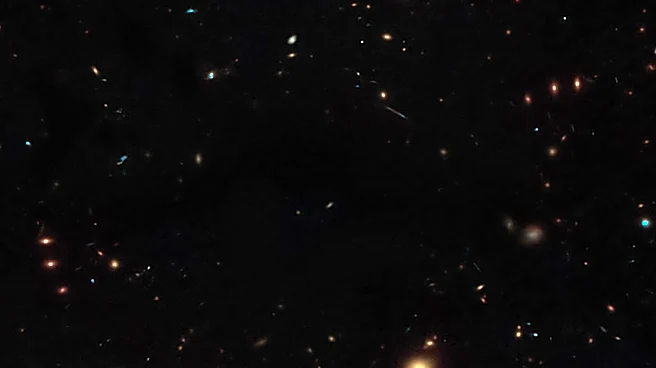
Astronomers have discovered a hidden glow along the jets of supermassive black holes, indicating that these jets heat hydrogen gas far beyond the visible edges of their galaxies. This heating prevents the gas from cooling and collapsing to form new stars.
The circumgalactic medium, which is 10 to 20 times larger than the visible part of a galaxy, contains vast reserves of material for star formation. However, this new finding suggests that the plasma jets from supermassive black holes disrupt this process. The maximum brightness of this glow occurs in two zones: one close to the galaxy where the jet first enters the gaseous envelope, and another near its outer edge where the plasma releases most of its energy. According to Namrata Roy, the black hole's influence extends for hundreds of thousands of light-years.
Why It's Important?
This discovery provides a crucial explanation for a long-standing puzzle in astrophysics: why relatively few new stars are formed despite the large reserves of material in the circumgalactic medium. The heating and disturbance of gas by black hole jets effectively slow down and can almost stop star formation. This has significant implications for understanding galactic evolution, as it explains why some galaxies become 'red and dead,' meaning they have ceased forming new stars. The research highlights the powerful and far-reaching influence of supermassive black holes, demonstrating their role as key regulators of star formation and galactic development. This understanding is vital for refining models of galaxy formation and evolution, offering new insights into the life cycles of galaxies across the universe.
What's Next?
The research team, led by Sanchayita Borthakur and Namrata Roy, utilized data from the Dark Energy Spectroscopic Instrument (DESI) survey and the Low Frequency Array (LOFAR) to detect this faint hydrogen emission. Future work will involve further analysis of this data and potentially new observations to confirm and expand upon these findings. The authors suggest that galaxy evolution theorists now have a way to observationally test how jets distribute energy in the surrounding gas. This will involve studying the orientation of jets to determine where matter is heated and where it remains available for new stars. The findings, published in The Astrophysical Journal Letters, will likely spur further investigations into the detailed mechanisms of energy transfer from black hole jets to the circumgalactic medium.
Beyond the Headlines
The detection of this hidden glow along black hole jets offers a deeper insight into the complex and dynamic processes that shape the universe. It reveals that the seemingly empty space surrounding galaxies is, in fact, a battleground of cosmic forces, where the immense power of supermassive black holes dictates the fate of star formation. This understanding challenges our perception of galactic tranquility, emphasizing the constant interplay between destructive and creative forces in the cosmos. The Milky Way's own central black hole, Sagittarius A*, may have exhibited similar activity in the past, as suggested by the Fermi bubbles. This research not only advances our scientific knowledge but also inspires a sense of wonder about the intricate workings of the universe and the profound impact of its most extreme objects.