







What's Happening?
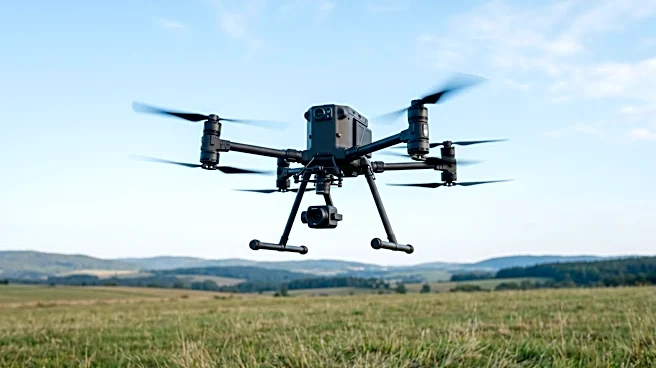
Sparc AI Inc. announced that its Overwatch software successfully guided a test drone at 60 kilometers per hour without GPS, delivering continuous position updates every second. This achievement is a significant milestone for the company's planned integration
with a major European drone manufacturer, following a memorandum of understanding signed on October 26. The Overwatch software also supports GPS-independent return-to-home capabilities, crucial for recovering drones in environments where satellite signals are unavailable or compromised. Concurrently, Sparc AI has expanded its market reach by signing a reseller agreement with a Polish group. This move targets a region experiencing significant GPS signal interference, with Poland's National Institute of Telecommunications reporting all-band satellite navigation interference on 70% of days in May and June. Researchers have attributed this disruption to Russian electronic warfare sites in Kaliningrad, affecting countries like Lithuania, Estonia, Latvia, Finland, and Sweden.
Why It's Important?
The successful GPS-free navigation test by Sparc AI addresses a critical vulnerability in modern drone operations, particularly in contested environments where GPS jamming and spoofing are increasingly prevalent. The ability of Overwatch to provide reliable positioning without satellite signals enhances the resilience and operational effectiveness of drones, reducing the risk of aircraft loss. This is particularly vital for military and security applications, as highlighted by the growing demand in regions like Poland and the Baltics, which are directly impacted by electronic warfare activities. The expansion into Poland positions Sparc AI to capitalize on this urgent need, offering a solution that can safeguard critical infrastructure and defense capabilities against sophisticated signal disruptions. The development underscores a broader shift towards GPS-independent navigation solutions, driven by geopolitical tensions and the evolving landscape of electronic warfare.
What's Next?
Sparc AI plans to integrate and evaluate its Overwatch software on two fixed-wing drone platforms from a major European manufacturer, providing engineering, training, and standby support. This collaboration could lead to significant commercial contracts, especially as the software proves its efficacy in real-world scenarios. The reseller agreement in Poland is expected to facilitate customer introductions, demonstrations, and commercial deployments in a region with high demand for GPS-independent solutions. Sparc AI is also pursuing partnerships and sales in other markets, including two Gulf nations, Ukraine, the United States, and Australia. The company's focus on software-only solutions, requiring no onboard hardware or GPS, positions it for rapid adoption across various drone platforms, potentially making it a standard in drone navigation in contested environments.
Beyond the Headlines
The increasing prevalence of GPS jamming and spoofing, particularly from state actors, signals a fundamental shift in modern warfare and security paradigms. This development highlights the vulnerability of systems reliant on satellite navigation and accelerates the demand for alternative, resilient positioning, navigation, and timing (PNT) solutions. The success of Sparc AI's software points to a future where autonomous systems can operate effectively even when traditional navigation methods are compromised, fostering greater operational independence and security. This technological advancement also raises broader questions about the future of electronic warfare, the need for robust national security infrastructure, and the potential for non-state actors to exploit such vulnerabilities. The ethical implications of advanced drone capabilities operating in GPS-denied environments also warrant consideration, particularly concerning accountability and control in complex operational theaters.