


What's Happening?
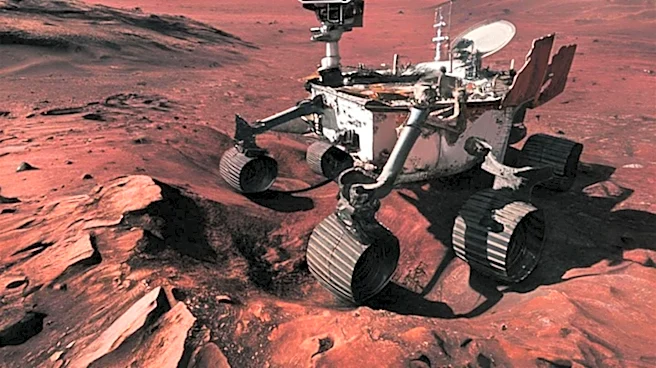
NASA's Curiosity rover is actively studying wind-blown sediments within Mars' Gale Crater to gain a deeper understanding of the planet's surface evolution. According to a mission update from NASA's Jet Propulsion Laboratory, the rover team recently executed
a demanding sequence of observations (sols 5002 to 5009) specifically targeting sedimentary structures shaped by Martian winds. This investigation aims to reveal the intricate interactions between dust, sand, and geological processes within the Gale Crater environment. Operating for over a decade on Mars, Curiosity continues to explore scientifically valuable regions, utilizing its instruments to analyze rocks and sediments directly from the Martian surface. This direct analysis provides insights that cannot be obtained through orbital observations alone, contributing to NASA's ongoing effort to reconstruct Mars' geological history and its transformation from a water-rich planet to its current arid state.
Why It's Important?
The study of wind-blown sediments on Mars is crucial for understanding the planet's past climate and geological processes. Unlike Earth, Mars' thin atmosphere and lack of active plate tectonics allow surface features to remain preserved for extended periods, making these sediments valuable records of atmospheric behavior and surface evolution. By examining the texture, composition, and structure of these deposits, scientists can infer past wind directions, surface stability, and the interplay of various geological forces. This research helps refine models of Martian climate, geology, and surface processes, offering a more complete picture of how the planet evolved. The data collected by Curiosity's instruments allows researchers to compare observations across different locations within Gale Crater, enhancing our comprehension of Mars' long-term environmental changes and its potential for past habitability.
What's Next?
As the Curiosity rover continues its journey through Gale Crater, researchers will utilize its ongoing measurements to further refine models of Martian climate, geology, and surface processes. The detailed investigations of small geological features are expected to reveal broader narratives about the entire planet's history. The rover team will continue to balance scientific objectives with the technical challenges of operating a spacecraft millions of miles away, requiring meticulous planning for every movement, instrument activity, and observation sequence. Future operations will likely involve further analysis of wind-shaped deposits, contributing to a more comprehensive understanding of how Mars transitioned from a planet with liquid water to its present colder and drier state. The insights gained will inform future Mars missions and the broader search for extraterrestrial life.
Beyond the Headlines
The meticulous work of the Curiosity rover in analyzing Martian wind-blown sediments extends beyond immediate scientific findings, touching upon fundamental questions about planetary evolution and the conditions necessary for life. The ability to reconstruct past environmental conditions on Mars through geological records offers a comparative planetology perspective, helping scientists understand Earth's own climate history and future. The operational challenges of controlling a rover on another planet, involving significant communication delays and the need for detailed pre-planning, highlight the ingenuity and perseverance of human space exploration. This ongoing mission underscores the long-term commitment to scientific discovery and the incremental nature of building knowledge about our solar system, with each new observation adding a piece to the complex puzzle of Mars' past and its potential for supporting life.