






What's Happening?
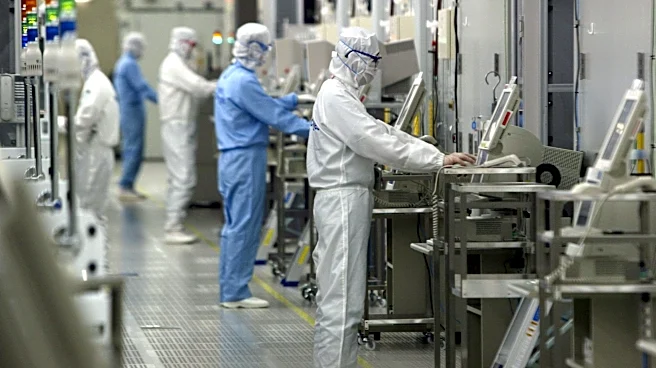
Rakesh Kumar, a professor of computer engineering at the University of Illinois Urbana-Champaign, recently discussed the intricate process of manufacturing modern semiconductors. His conversation highlighted the significant environmental and geopolitical
implications associated with AI data centers. Kumar also addressed how the rapid evolution of AI models is fundamentally altering the future landscape of chip design. This discussion delves into the technical complexities involved in producing the advanced chips that power contemporary technology, emphasizing the scale of resources and global coordination required. The professor's insights draw from his extensive work in the field, including his book, 'The Chip Age,' which explores the history and future trajectory of semiconductors. The conversation underscores the critical role these components play in the ongoing technological revolution and the challenges inherent in their production and deployment.
Why It's Important?
The discussion on semiconductor manufacturing and AI's influence is crucial due to the foundational role these technologies play in the U.S. economy and national security. Semiconductors are essential components in virtually all modern electronic devices, from consumer electronics to advanced military systems. The complexity and environmental footprint of their production raise significant concerns regarding supply chain resilience, resource consumption, and geopolitical dependencies. As AI models continue to advance, their demand for increasingly powerful and specialized chips drives innovation but also intensifies the pressure on manufacturing capabilities and energy resources. Understanding these dynamics is vital for policymakers, industry leaders, and the public to navigate the economic opportunities and strategic challenges presented by the 'chip age.' The insights from experts like Professor Kumar help illuminate the intricate connections between technological progress, environmental sustainability, and international relations.
What's Next?
The ongoing evolution of AI models is expected to continue driving demand for more sophisticated and energy-efficient semiconductors, prompting further research and development in chip design and manufacturing processes. This will likely lead to increased investment in semiconductor fabrication plants, both domestically and internationally, as nations strive for greater self-sufficiency and technological leadership. Discussions around the environmental impact of AI data centers will also intensify, potentially leading to new regulations or industry standards for energy consumption and sustainable practices. Furthermore, geopolitical considerations related to semiconductor supply chains are likely to remain a prominent feature of international relations, with countries continuing to vie for control over critical manufacturing capabilities and intellectual property. The insights shared by Professor Kumar suggest a future where the interplay between AI, chip technology, and global policy will become even more complex and critical.
Beyond the Headlines
Beyond the immediate technical and economic implications, the discussion on semiconductors and AI touches upon deeper societal transformations. The increasing reliance on advanced chips for AI applications raises ethical questions about the future of work, data privacy, and algorithmic bias. The environmental impact of AI data centers, often overlooked, highlights the hidden costs of technological progress and the need for more sustainable computing solutions. Geopolitically, the 'chip age' is reshaping global power dynamics, with control over semiconductor technology becoming a key determinant of national influence and economic competitiveness. This creates a complex web of dependencies and rivalries that could lead to significant shifts in international alliances and trade policies. Understanding these broader implications is essential for anticipating and addressing the long-term challenges and opportunities presented by the rapid advancements in AI and semiconductor technology.