



What's Happening?
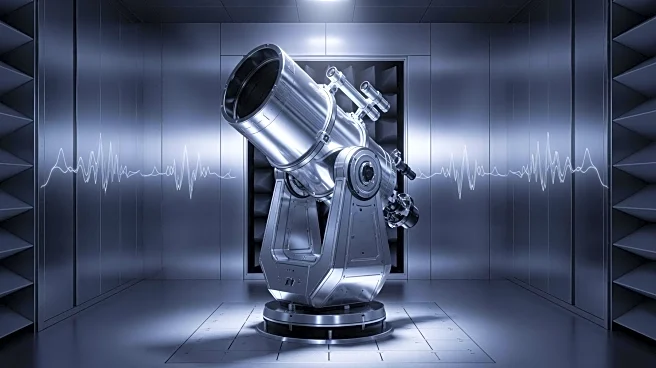
NASA's Nancy Grace Roman Space Telescope has successfully completed environmental testing at the Goddard Space Flight Center in Maryland. The telescope was subjected to acoustic waves reaching 138 decibels, simulating the intense conditions it will face
during launch. This testing is crucial to ensure the telescope's structural integrity and functionality in space. The Roman Space Telescope, equipped with an 8-foot mirror and a coronagraph, is designed to explore cosmic phenomena, including dark energy and alien planets. It is expected to launch in fall 2026, offering a field of view 100 times larger than the Hubble Space Telescope.
Why It's Important?
The Roman Space Telescope represents a significant advancement in space exploration technology, promising to enhance our understanding of the universe. Its ability to map cosmic structures and detect distant celestial bodies will provide valuable data for astronomers. The successful testing phase is a critical milestone, ensuring the telescope's readiness for its mission. The project, with an estimated cost of over $4 billion, underscores NASA's commitment to advancing space science and technology.
What's Next?
Following the successful acoustic testing, the Roman Space Telescope will undergo further evaluations to ensure all systems are operational before its scheduled launch. NASA will continue to prepare for the telescope's deployment, focusing on finalizing its instruments and mission parameters. Once operational, the telescope is expected to contribute significantly to our understanding of the cosmos, potentially leading to groundbreaking discoveries in astronomy.