
What's Happening?
China has rapidly advanced in the electrification of heavy transport vehicles, particularly battery-electric concrete mixers. Over the past five years, these vehicles have transitioned from niche products
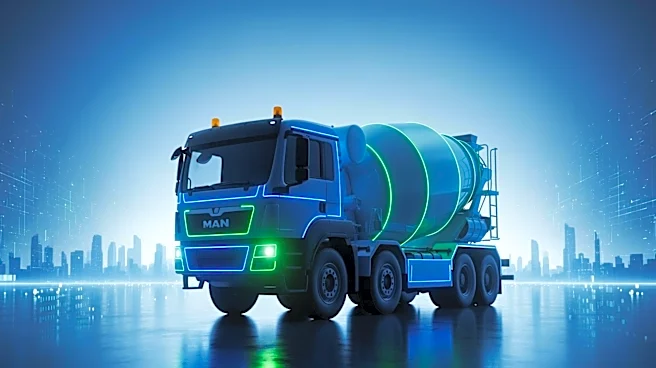
to a significant category in China's new sales market. In 2021, China sold 1,309 new-energy concrete mixers, with sales increasing to 8,036 by 2024, representing a penetration rate of 43.8%. By 2025, industry estimates suggest sales could exceed 20,000 units, with a penetration rate approaching 70%. This growth is attributed to China's domestic heavy truck manufacturing capabilities, large battery suppliers, urban air-quality pressures, and supportive policy tools. The country also benefits from a large construction equipment market, which facilitates learning effects and infrastructure development for battery swapping. This trend contrasts with other countries where electric concrete mixers remain in early stages, with limited deployments and trials.
Why It's Important?
The rapid adoption of electric concrete mixers in China underscores the country's strategic alignment of policy, manufacturing, and infrastructure to support electrification. This development is significant for global heavy truck markets, as it demonstrates a viable pathway for electrifying vehicles traditionally considered difficult due to their weight and operational demands. The shift towards battery-electric vehicles in China could influence global markets by setting a precedent for other countries to follow. It highlights the potential for reduced emissions and operational costs, as electric mixers displace diesel, lower maintenance needs, and offer access to low-emission zones. However, the transition requires substantial infrastructure investment, particularly in charging and battery swapping facilities, which may pose challenges for other countries lacking China's scale and standardization.
What's Next?
As China continues to lead in the electrification of concrete mixers, other countries may look to replicate its success by aligning policy and infrastructure development. Fleet operators and policymakers outside China are encouraged to treat early deployments as pilots to understand operational requirements and optimize routes for electric vehicles. The focus will likely be on developing charging infrastructure and standardizing battery swapping to facilitate broader adoption. Policymakers may also implement supportive measures such as low-emission construction zones and public procurement requirements to drive market shifts. The global market will need to address challenges such as battery costs, grid capacity, and standardization to achieve similar penetration rates.
Beyond the Headlines
The electrification of concrete mixers in China highlights broader implications for the global transition to electric heavy vehicles. It challenges the notion that certain vehicle categories are too difficult to electrify, suggesting that predictability in operations can facilitate electrification. The success in China may prompt a reevaluation of hydrogen fuel cells for heavy vehicles, as battery-electric options prove more efficient and cost-effective for known routes and operations. This development could accelerate the shift towards electric vehicles in other sectors, influencing global emissions reduction efforts and shaping future transportation policies.