





What's Happening?
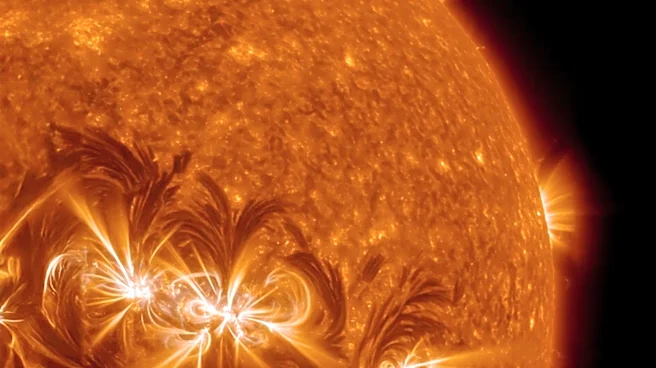
Scientists have developed a new method to predict the strength of the sun's next activity cycle up to seven years in advance. This method uses the number of sunspots at a newly identified 'switch-off' point in the solar cycle, where the sun's extreme
space weather events suddenly end. The research, presented at the Royal Astronomical Society's National Astronomy Meeting, suggests that Solar Cycle 26 will be moderate, with a sunspot number similar to or weaker than the current cycle. The method builds on the 'sunclock' concept, mapping the sun's irregular cycles onto a standard clock to predict future solar activity.
Why It's Important?
Accurate predictions of solar activity are crucial for preparing for space weather events that can impact satellites, communications, navigation systems, and power grids on Earth. The new method offers a longer lead time for forecasting solar cycles, potentially improving preparedness and mitigation strategies for industries and governments. Understanding solar dynamics also contributes to scientific knowledge about the sun's behavior and its effects on the solar system.
What's Next?
Researchers plan to refine their predictions once Solar Cycle 25 reaches the 'switch-off' point, allowing for more precise forecasts based on observations. This advancement could lead to better planning and response strategies for space weather events, benefiting sectors reliant on satellite technology and infrastructure. Continued research will focus on enhancing the understanding of the solar dynamo, the process generating the sun's magnetic field.