





What's Happening?
Delaware's aquaculture industry has seen a substantial growth spurt over the past five years, according to researchers from the University of Delaware’s School of Marine Science & Policy College Sea Grant. Dr. Edward Hale, who specializes in Fisheries
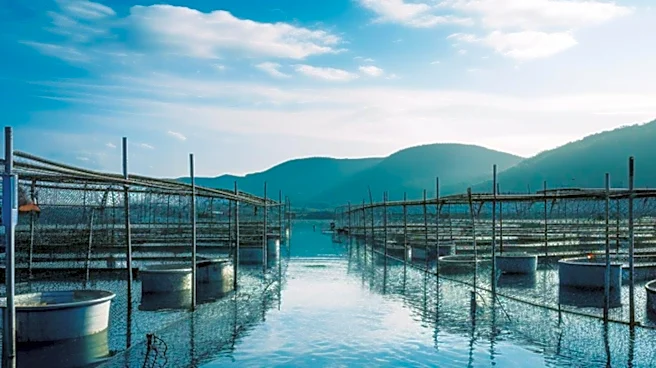
and Aquaculture at the Sea Grant and is an associate professor at the University of Delaware, noted the addition of four new shellfish farmers in the last year. This expansion is partly attributed to regulatory changes at the state level. The Sea Grant, a partnership between the National Oceanic and Atmospheric Administration (NOAA) and universities, has collaborated to create an oyster hatchery that supplies seed oysters to farmers in Rehoboth Bay. Representative Jeff Hilovsky (R-District 4) co-sponsored a resolution establishing a task force dedicated to Delaware’s aquaculture, aiming to explore farming in inland bays while emphasizing the need for healthy bay ecosystems, which oysters contribute to significantly.
Why It's Important?
The growth of Delaware's aquaculture industry holds significant importance for both the state's economy and its environmental health. The expansion of shellfish farming, particularly oysters, contributes to sustainable seafood production, offering a local and environmentally friendly food source. Economically, this growth creates jobs and supports local communities involved in farming, processing, and distribution. Environmentally, oysters play a crucial role in water purification, with each oyster filtering approximately 500 gallons of water daily. This natural filtration helps reduce turbidity, leading to clearer waters and healthier aquatic habitats, which in turn supports other marine life like black sea bass and tautog. The legislative support, exemplified by Rep. Hilovsky's task force initiative, underscores a commitment to fostering this industry, recognizing its dual benefits for economic development and ecological restoration. This model could serve as an example for other coastal states looking to balance economic growth with environmental stewardship.
What's Next?
The task force established by the resolution co-sponsored by Rep. Jeff Hilovsky will continue to explore opportunities for aquaculture in Delaware's inland bays. Their findings and recommendations are expected to guide future regulatory frameworks and support initiatives for the industry. Continued collaboration between the University of Delaware, Delaware State University, and the Sea Grant will likely focus on research and development to enhance oyster farming techniques and expand hatchery operations. Efforts will also be directed towards educating the public about the benefits of sustainable seafood production and the ecological role of oysters. The success of these initiatives could lead to further investment in aquaculture infrastructure and potentially attract more farmers to the sector, solidifying Delaware's position as a leader in sustainable shellfish production. Monitoring the health of the inland bays will be a continuous process, with oyster populations serving as a key indicator of environmental improvement.
Beyond the Headlines
The resurgence of Delaware's aquaculture, particularly oyster farming, highlights a broader shift towards integrating ecological benefits with economic activities. This approach moves beyond traditional resource extraction to a more symbiotic relationship with natural ecosystems. The emphasis on oysters as natural water filters underscores their role as 'ecosystem engineers,' providing services that are often undervalued in economic models. This development could influence public policy debates on coastal management, demonstrating how targeted investments in sustainable industries can yield significant environmental returns. Furthermore, it raises awareness about the interconnectedness of human activities and environmental health, promoting a more holistic view of resource management. The success in Delaware could inspire other regions to explore similar nature-based solutions for economic development and environmental restoration, fostering a more resilient and sustainable blue economy.