









What's Happening?
The Royal Canadian Navy (RCN) has officially accepted its first uncrewed rotorcraft, the Shiebel S-100, locally designated as the CU179 Peregrine. This development follows a successful factory acceptance test. The CU179 Peregrine is set to operate from
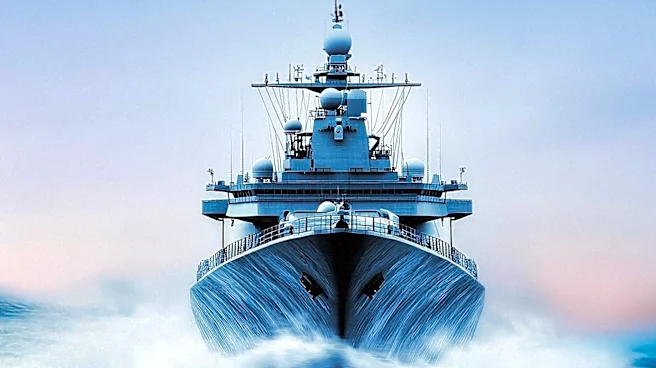
Canada's Halifax-class naval frigates, providing aerial intelligence, surveillance, and reconnaissance support. The uncrewed aerial system (UAS) is equipped with advanced surveillance sensors, enhancing situational awareness for the RCN in complex maritime environments. The initial order includes two Peregrines valued at C$39 million, with the possibility of expanding to six aircraft. The Peregrine will work alongside Sikorsky CH-148 Cyclone maritime helicopters, which already provide air support to the Halifax frigates. The integration of the S-100 rotorcraft aligns with similar deployments by the UK Royal Navy, French Navy, and Greek Navy.
Why It's Important?
The integration of the S-100 uncrewed rotorcraft into the Royal Canadian Navy's operations marks a significant advancement in maritime surveillance capabilities. By enhancing situational awareness, the RCN can operate more effectively in increasingly complex maritime environments. This development is crucial for maintaining national security and maritime sovereignty, especially in the context of evolving global maritime threats. The use of advanced surveillance technology also positions Canada alongside other leading naval forces, such as the UK and France, which have already adopted similar systems. The investment in uncrewed systems reflects a broader trend in military modernization, emphasizing the importance of technological innovation in defense strategies.
What's Next?
The Royal Canadian Navy may expand its order of the CU179 Peregrine to six aircraft, depending on the success of the initial deployment. This expansion would further enhance the RCN's surveillance capabilities. Additionally, the collaboration with Canadian space hardware manufacturer MDA and Austria-based Shiebel could lead to further technological advancements and partnerships in the defense sector. As the RCN continues to integrate uncrewed systems, there may be increased focus on training and operational protocols to maximize the effectiveness of these new technologies.