








What's Happening?
The City of Fort Collins is now investing in the Northern Integrated Supply Project (NISP), a major water initiative in Northern Colorado, after more than 20 years of opposition. This decision marks a significant shift in the city's strategy for securing
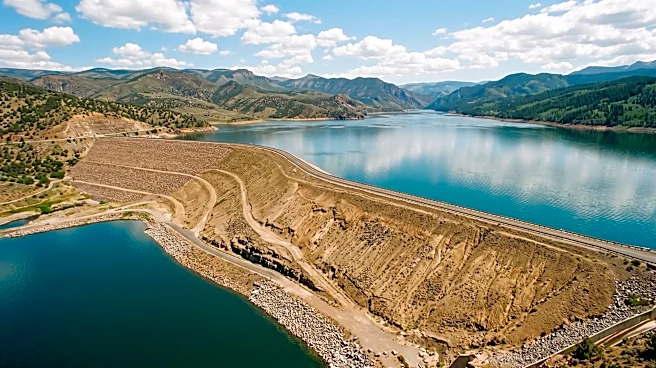
its future water supplies. Fort Collins plans to utilize a portion of the proposed Glade Reservoir, part of NISP, to store existing water rights. According to Nicole Poncelet-Johnson, the city's One Water executive director, joining NISP offers a more affordable and practical solution compared to the previous plan of expanding Halligan Reservoir. The expansion of Halligan Reservoir faced significant regulatory hurdles, with the U.S. Army Corps of Engineers indicating it would not be permitted. Changes made to NISP, which include additional protections for the Poudre River, influenced Fort Collins' reconsideration. The city's investment in NISP is projected to be approximately $300 million over 40 years, a substantial reduction from the estimated $500 million cost for the Halligan Reservoir expansion.
Why It's Important?
This decision by Fort Collins is important for several reasons, primarily concerning regional water management and infrastructure development in the U.S. West. The shift from opposing to joining NISP highlights the increasing pressure on municipalities to find sustainable and cost-effective water solutions amidst growing populations and climate change impacts. By opting for NISP, Fort Collins aims to secure its water future more affordably, potentially setting a precedent for other cities facing similar challenges. The project's ability to store senior water rights is crucial for maintaining a reliable water supply, especially with uncertainties surrounding the Colorado River and diminishing water resources. This move could also influence future regional collaborations on large-scale infrastructure projects, demonstrating how modifications and cost-benefit analyses can lead to consensus on previously contentious issues. Ratepayers in Fort Collins stand to benefit from a more affordable long-term water storage solution.
What's Next?
As Fort Collins moves forward with its investment in NISP, the next steps will involve the continued development and construction of the Glade Reservoir. A portion of U.S. Highway 287 will need to be relocated to accommodate the reservoir's construction, which will impact traffic flow between Fort Collins and Laramie, Wyoming. The city plans to use about 6% of Glade Reservoir's future capacity for its water rights. This long-term commitment, spanning 40 years, will require ongoing financial contributions and oversight from Fort Collins. The success of NISP and its ability to provide reliable water storage will be closely monitored, particularly as the region grapples with the effects of climate change and water scarcity. Other municipalities in Northern Colorado may observe Fort Collins' experience to inform their own water management strategies and potential participation in regional water projects.
Beyond the Headlines
The decision by Fort Collins to join NISP reflects a broader national trend of communities re-evaluating long-held positions on environmental and infrastructure projects in response to evolving challenges. This shift underscores the complex interplay between economic feasibility, environmental concerns, and the pressing need for resource security. The initial opposition to NISP, rooted in environmental concerns regarding the Poudre River, and the subsequent acceptance after project modifications, illustrate the potential for compromise and adaptive management in large-scale public works. This case also highlights the critical role of regulatory bodies, such as the U.S. Army Corps of Engineers, in shaping the viability of infrastructure projects. The long-term implications extend to regional planning, as the relocation of a major highway for the reservoir's construction signifies the significant land-use changes that can accompany such projects, impacting local ecosystems and transportation networks for generations.