

What's Happening?
A recent study has provided new insights into the fossilization process of soft-bodied organisms from the Ediacaran era, which predates the Cambrian explosion. This era, occurring between 541 and 530 million years ago, is crucial for understanding the origins
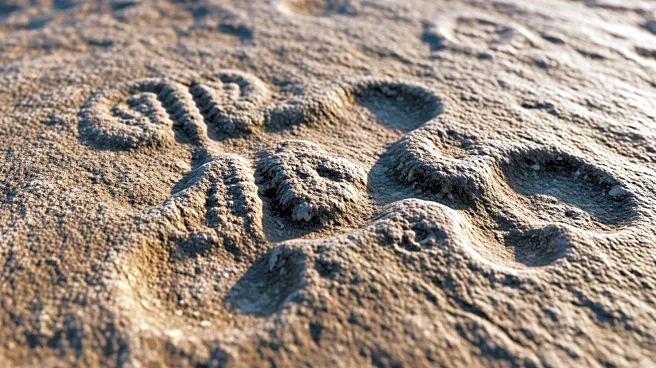
of complex life on Earth. The fossils, discovered in Newfoundland, were preserved in sandstone, a medium not typically conducive to fossil preservation due to its porosity and vulnerability to water currents. However, the study reveals that the grains of sand acted as a substrate for clay formation, derived from iron and silicate-rich seawater. This natural cementation process preserved the detailed impressions of these ancient organisms, which are characterized by unique features such as triradial symmetry and fractal patterning. Dr. Lidya Tarhan, a paleontologist at Yale University, emphasizes the importance of understanding these preservation mechanisms to accurately interpret the fossil record of early life.
Why It's Important?
The findings are significant as they challenge previous assumptions that fossilization of soft-bodied organisms depended on their physical toughness. Instead, the study highlights the role of environmental conditions in preserving these delicate forms. This understanding is crucial for paleontologists as it provides a more accurate picture of early life on Earth, particularly during the Ediacaran era, which is a critical point in the trajectory of complex life. By uncovering the mechanisms behind exceptional fossilization, scientists can better assess the fidelity of fossil assemblages, offering insights into the biodiversity and ecological dynamics of ancient ecosystems. This research not only enhances our understanding of evolutionary history but also informs current studies on biodiversity and conservation.
What's Next?
Future research will likely focus on exploring other fossil sites to determine if similar preservation processes occurred elsewhere. This could lead to the discovery of more well-preserved fossils, providing further insights into the diversity and complexity of early life forms. Additionally, scientists may investigate the chemical and physical conditions that facilitated such preservation, potentially uncovering new information about the ancient environments these organisms inhabited. These studies could also inform modern conservation efforts by highlighting the importance of environmental conditions in preserving biodiversity.
Beyond the Headlines
The study of Ediacaran fossils not only contributes to our understanding of early life but also raises questions about the evolutionary pathways that led to modern biodiversity. The unique features of these organisms challenge traditional classifications and suggest that the tree of life may be more complex than previously thought. This research underscores the importance of interdisciplinary approaches, combining paleontology, geology, and chemistry, to unravel the mysteries of Earth's early history. It also highlights the potential for new discoveries that could reshape our understanding of life's origins and evolution.