
What's Happening?
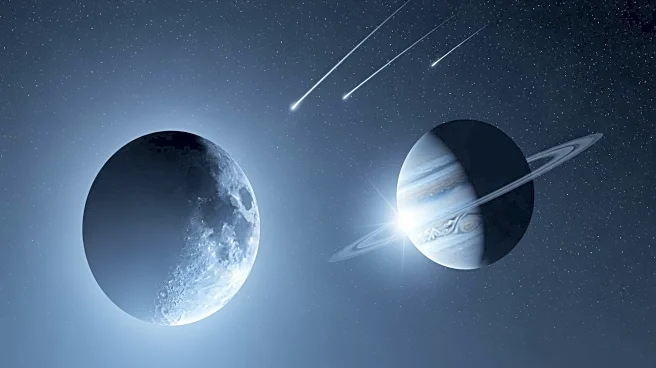
On December 20, 2025, skywatchers are treated to a series of astronomical events. The New Moon creates optimal dark-sky conditions, enhancing visibility for stargazing. Jupiter is prominently visible in the
evening sky, rising soon after sunset and remaining visible until dawn. This period marks Jupiter's approach to opposition, which will occur on January 10, 2026, making it appear larger and brighter. Additionally, the Ursid meteor shower is building towards its peak, offering a chance to observe meteors under minimal moonlight interference. An interstellar comet, 3I/ATLAS, is also visible through telescopes, having recently made its closest approach to Earth. These events coincide with the winter solstice on December 21, 2025, providing extended nighttime hours for observation.
Why It's Important?
These astronomical events offer significant opportunities for both amateur and professional astronomers. The absence of moonlight due to the New Moon allows for clearer views of faint celestial objects, enhancing the stargazing experience. Jupiter's visibility provides a chance to observe one of the solar system's largest planets in detail. The Ursid meteor shower, with its peak coinciding with the New Moon, offers an excellent opportunity for meteor observation without the usual interference from moonlight. The presence of the interstellar comet 3I/ATLAS is particularly noteworthy, as it represents a rare opportunity to study an object from outside our solar system, potentially offering insights into the composition and behavior of interstellar bodies.
What's Next?
As Jupiter approaches opposition on January 10, 2026, it will become even more prominent in the night sky, providing further opportunities for observation. The Ursid meteor shower will peak on December 21-22, 2025, offering the best chance to observe meteors. The interstellar comet 3I/ATLAS will remain observable into spring 2026, although its visibility will decrease as it moves away from Earth. These events encourage continued observation and study, potentially leading to new discoveries and a deeper understanding of our universe.