



What's Happening?
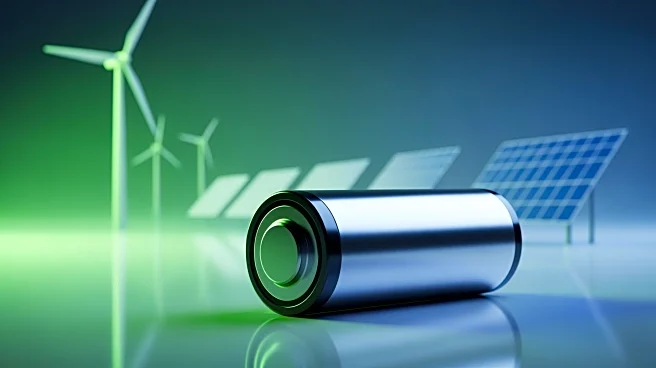
Massachusetts has enacted a significant law aimed at enhancing its energy storage capabilities, signed by Governor Maura Healey. The law mandates the installation of 5,000 megawatts (MW) of battery storage by 2030, with specific requirements for the duration
of energy storage. The law categorizes the storage into three groups: 3,500 MW for 4 to 10 hours, 750 MW for 10 to 24 hours, and 750 MW for at least 24 hours. This initiative is part of a broader effort to support renewable energy integration and ensure grid reliability. Form Energy, a company based in Somerville, Massachusetts, is at the forefront of this development, working on iron-air batteries capable of providing 100 hours of energy at full discharge. These batteries are being installed in Minnesota, showcasing their potential for long-duration energy storage.
Why It's Important?
The Massachusetts battery storage law represents a critical step in transitioning to renewable energy sources by addressing the intermittency of solar and wind power. By requiring long-duration storage solutions, the state aims to enhance grid stability and reduce reliance on fossil fuels. This move could set a precedent for other states, encouraging the adoption of innovative storage technologies like Form Energy's iron-air batteries. The success of this initiative could lead to significant economic and environmental benefits, including job creation in the clean energy sector and a reduction in greenhouse gas emissions. However, the challenge remains in scaling these technologies to meet the ambitious targets set by the law.
What's Next?
As Massachusetts progresses with its energy storage plans, the focus will be on the deployment and performance of these new battery technologies. Stakeholders, including policymakers, energy companies, and environmental groups, will closely monitor the implementation to ensure it meets the state's energy goals. The success of Form Energy's iron-air batteries could lead to further investments and advancements in long-duration storage solutions. Additionally, other states may look to Massachusetts as a model for integrating similar storage mandates into their renewable energy strategies.
Beyond the Headlines
The Massachusetts battery storage law highlights the growing importance of energy storage in the transition to a sustainable energy future. It underscores the need for technological innovation to overcome the limitations of current battery technologies, such as lithium-ion, which may not be suitable for long-duration applications. The development of iron-air batteries by Form Energy represents a significant breakthrough, offering a cost-effective and scalable solution for grid storage. This could lead to a paradigm shift in how energy is stored and utilized, with potential implications for energy policy and infrastructure development across the United States.