
What's Happening?
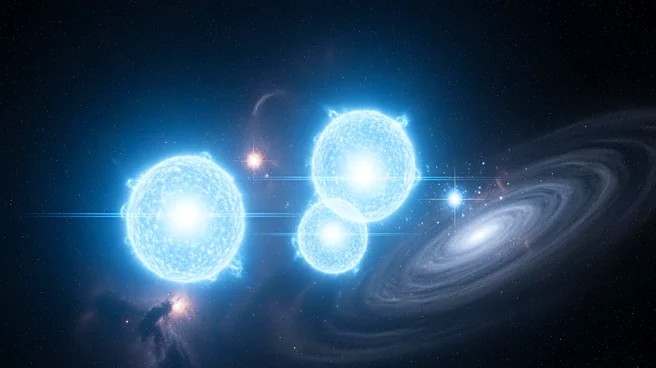
Astronomers have made a groundbreaking discovery using NASA's James Webb Space Telescope (JWST), identifying 'monster stars' that existed in the early universe. These stars, weighing between 1,000 and
10,000 times the mass of our Sun, were found in a galaxy named GS 3073. The discovery was made by analyzing the chemical signatures within the galaxy, particularly the nitrogen-to-oxygen ratio, which was found to be significantly higher than what can be explained by known stellar phenomena. This finding provides the first direct evidence of such massive stars, which are believed to have existed during the universe's first few hundred million years, a period known as the 'cosmic Dark Ages.' These stars likely played a crucial role in the formation of supermassive black holes, which are some of the brightest objects in the universe.
Why It's Important?
The discovery of 'monster stars' is significant as it helps solve a long-standing cosmic mystery about the formation of supermassive black holes shortly after the Big Bang. Understanding these stars provides insights into the early universe's chemical evolution and the processes that led to the formation of galaxies and black holes. The presence of such massive stars suggests that the first generation of stars included supermassive objects that contributed to the enrichment of the universe with heavy elements. This finding could reshape our understanding of the early universe and the conditions that led to the formation of the complex structures we observe today.
What's Next?
Researchers anticipate that the James Webb Space Telescope will continue to uncover more galaxies with similar nitrogen excesses, further supporting the existence of these ultra-massive first stars. Each new discovery will enhance our understanding of the early universe and the role these stars played in shaping it. The ongoing study of these chemical signatures could also provide more clues about the formation of supermassive black holes and the evolution of galaxies. As more data is collected, scientists hope to refine their models and gain a deeper understanding of the universe's formative years.
Beyond the Headlines
The discovery of 'monster stars' not only addresses questions about the early universe but also opens up new avenues for research into the lifecycle of stars and the formation of black holes. The unique chemical signatures observed in GS 3073 could lead to a reevaluation of stellar evolution models and the processes that govern the birth and death of stars. This research also highlights the importance of advanced telescopes like the JWST in exploring the universe's distant past and uncovering phenomena that were previously beyond our reach.