



What's Happening?
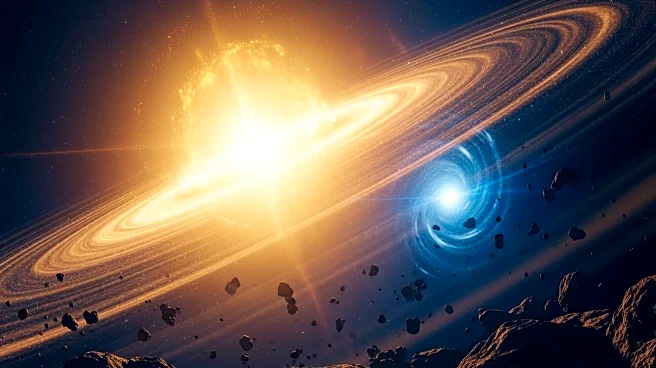
Researchers at the University of Tokyo have proposed a new model suggesting that a nearby supernova explosion may have played a crucial role in shaping the solar system and Earth. The study, led by Ryo Sawada, indicates that a supernova occurring approximately
3 light years away could have provided the necessary radioactive elements without disrupting the planet formation process. This model suggests that the supernova's shock waves carried radioactive elements like aluminium and manganese to the early solar system, while cosmic rays from the supernova produced additional elements such as beryllium and calcium. This process could have ensured the right conditions for Earth to develop its water content, essential for life.
Why It's Important?
The findings challenge previous models that required supernovae to be much closer, which would have likely destroyed the early solar system. By suggesting a more distant supernova, the study implies that the conditions for forming Earth-like planets may be more common than previously thought. This could significantly impact the search for Earth-like planets, as it suggests that up to 50% of sun-like stars could host planets with similar conditions. The research provides a new perspective on the formation of planetary systems and could guide future astronomical studies and missions aimed at discovering habitable worlds.
What's Next?
Future research and space missions, such as NASA's planned Habitable Worlds Observatory, may focus on identifying star systems that were near supernovae at the time of their explosions. By tracing the remnants of ancient supernovae, scientists could better understand the distribution of Earth-like planets across the galaxy. This approach could refine the criteria for selecting targets in the search for extraterrestrial life and habitable planets, potentially leading to groundbreaking discoveries in the field of astronomy.
Beyond the Headlines
The study highlights the delicate balance between destruction and creation in the universe. It underscores the role of cosmic events in shaping planetary systems and the potential universality of the processes that led to Earth's formation. This research could also influence our understanding of the galaxy's history and the frequency of life-supporting conditions beyond our solar system.