



What's Happening?
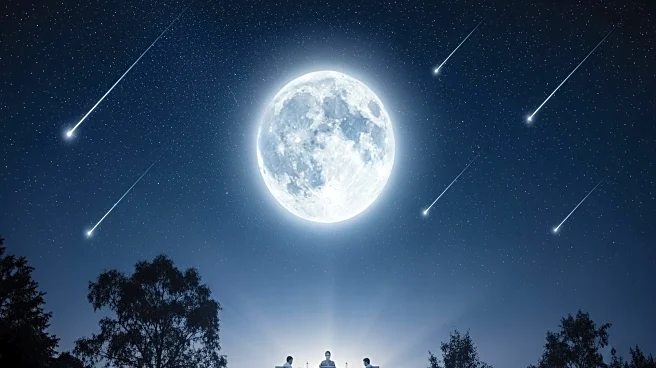
In 2026, sky enthusiasts in the United States and around the world can look forward to a series of captivating celestial events. The year will feature 13 full moons, including three supermoons, with the closest supermoon occurring in December. The year will also
see two solar eclipses and two lunar eclipses. A total solar eclipse will be visible in parts of Greenland, Iceland, Spain, Russia, and Portugal on August 12, while a partial eclipse will be visible in Europe, Africa, and North America. Additionally, the Perseids and Geminids meteor showers are expected to be the highlights of the year, with the Perseids peaking without lunar interference. Other notable events include a parade of six planets visible in February and a series of planetary alignments throughout the year.
Why It's Important?
These celestial events offer significant opportunities for scientific observation and public engagement with astronomy. The visibility of multiple supermoons and eclipses provides a chance for educational outreach and increased interest in space science. Meteor showers like the Perseids and Geminids are popular for their visual spectacle, drawing attention to the natural wonders of the night sky. Such events can inspire interest in STEM fields among students and the general public. Additionally, the visibility of these events across different regions highlights the global nature of astronomical phenomena, fostering a sense of shared experience and curiosity about the universe.
What's Next?
As these celestial events approach, organizations like NASA and local astronomical societies are likely to organize viewing events and educational programs to maximize public engagement. Safety measures, such as the use of proper eclipse glasses, will be emphasized to ensure safe viewing of solar eclipses. The events may also prompt increased media coverage and social media activity, as people share their experiences and observations. For amateur astronomers and photographers, these events present opportunities to capture unique images and contribute to citizen science projects.