





What's Happening?
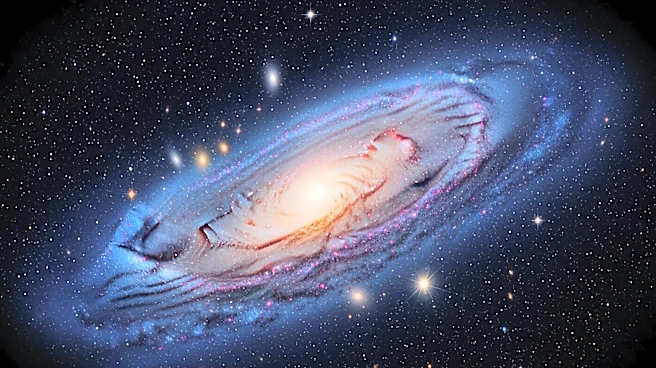
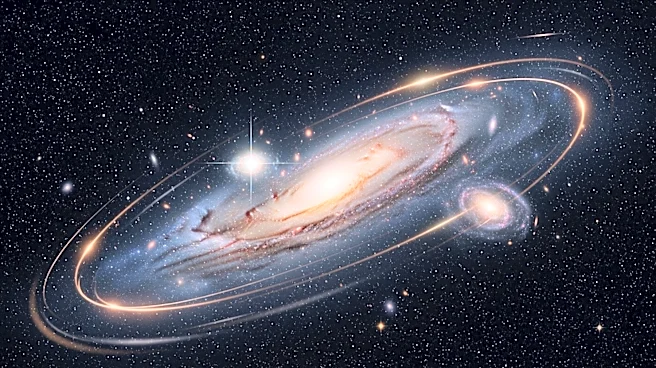
Astrophysicists are debating whether the Large Magellanic Cloud (LMC), the Milky Way's largest satellite galaxy, is approaching our galaxy for the first time or if it has visited before. A recent study supports the 'first-pass' theory, suggesting that
the LMC is nearing the Milky Way for the first time in history. This conclusion is based on computer simulations of the gas halos of both galaxies, which align with the first-pass scenario. However, an alternative hypothesis, the 'second passage' theory, posits that the LMC's current position and velocity fit a scenario where it first passed the Milky Way 6-8 billion years ago. The debate remains unresolved, with both theories having supporting evidence.
Why It's Important?
The outcome of this debate has significant implications for understanding the Milky Way's evolution and the dynamics of its satellite galaxies. The LMC's approach affects the gravitational interactions and the distribution of dark matter within the Milky Way. Resolving this debate could provide insights into the history and future of our galaxy's structure. The research highlights the complexity of galactic interactions and the challenges in modeling such large-scale cosmic events. The findings also emphasize the importance of advanced simulations and observational data in astrophysics.
What's Next?
Further research and observations are needed to conclusively determine the LMC's passage history. NASA's upcoming Aspera mission may provide direct insights into the shape and distribution of the Magellanic gas, potentially settling the debate. Continued advancements in simulation technology and observational techniques will be crucial in resolving this longstanding astrophysical question.