





What's Happening?
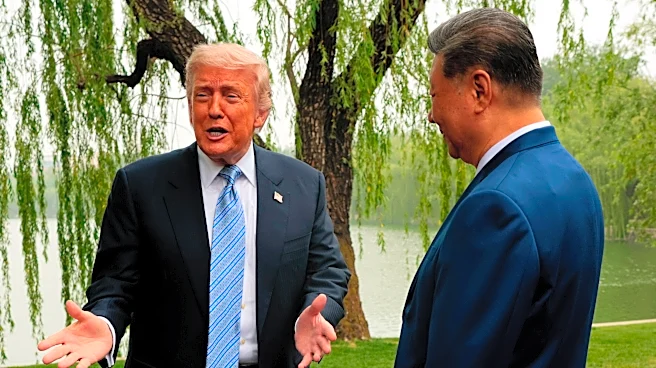
President Trump recently met with Chinese President Xi Jinping, marking their second meeting within a year. During the discussions, President Trump emphasized the need for both China and Taiwan to 'cool it,' suggesting a de-escalation of tensions. He
reiterated the U.S.'s long-standing 'One China' policy, which maintains strategic ambiguity regarding Taiwan's status. This policy leaves open the question of whether the U.S. would defend Taiwan in the event of a Chinese attack. President Trump also mentioned that Taiwan was not a topic of discussion during his previous meeting with Xi in South Korea. He expressed reluctance to support Taiwan's independence, indicating that the U.S. is not eager to engage in a conflict over the island. Additionally, President Trump has not yet decided on a potential large arms sale to Taiwan, further reflecting the cautious U.S. stance.
Why It's Important?
The meeting between President Trump and President Xi is significant as it highlights the delicate balance the U.S. maintains in its relations with China and Taiwan. The strategic ambiguity policy allows the U.S. to navigate its diplomatic ties with China while supporting Taiwan's self-defense capabilities. This approach is crucial for maintaining regional stability in East Asia, where tensions over Taiwan could escalate into broader conflicts. The U.S.'s stance impacts international relations, as it influences China's actions towards Taiwan and affects Taiwan's security and political decisions. The outcome of these discussions could have implications for U.S. defense policies and arms sales, affecting defense contractors and regional security dynamics.
What's Next?
Future developments may include further diplomatic engagements between the U.S., China, and Taiwan to address ongoing tensions. The U.S. may continue to evaluate its arms sales to Taiwan, balancing its commitments under the Taiwan Relations Act with the need to manage relations with China. Stakeholders, including political leaders and defense industries, will closely monitor these interactions for any shifts in policy or strategy. The international community will also watch for China's response to the U.S.'s reaffirmation of strategic ambiguity, as it could influence China's approach to Taiwan and regional security.