






What's Happening?
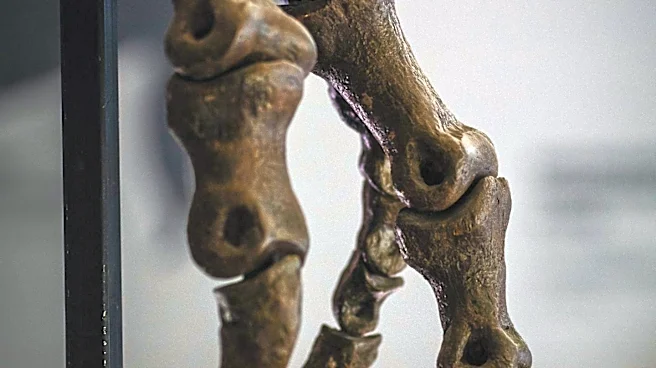
A Denisovan mandible discovered in 2019 in Baishiya Karst Cave on the Tibetan Plateau has provided significant insights into the ancient human lineage. The mandible, dating back at least 160,000 years, was found at an altitude of about 3,280 meters above
sea level. This discovery indicates that Denisovans occupied high altitudes long before the formation of present-day Tibetan populations. Although no usable Denisovan DNA was recovered from the jaw, ancient proteins helped identify the Denisovan lineage. The exact donor population remains unknown, but the finding supports the theory that Denisovans contributed to the genetic makeup of modern Tibetans, particularly in their adaptation to high altitudes.
Why It's Important?
The discovery of the Denisovan mandible is crucial for understanding human evolution and adaptation. It highlights the Denisovans' ability to survive in high-altitude environments, which is significant for studying how modern humans adapted to similar conditions. The genetic legacy of Denisovans, particularly the EPAS1 gene variant, is prevalent among Tibetans, aiding their survival in low-oxygen environments. This finding underscores the impact of ancient interbreeding on modern human populations, providing insights into genetic adaptations that have persisted over millennia.
What's Next?
Further research is needed to explore the extent of Denisovan influence on modern human genetics. Scientists aim to recover more genetic material from Denisovan fossils to better understand their contribution to human evolution. Additionally, studies on the EPAS1 gene variant could lead to advancements in medical research, particularly in understanding and treating conditions related to oxygen deficiency. The ongoing exploration of Denisovan sites may uncover more fossils, offering deeper insights into their lifestyle and interactions with other human species.
Beyond the Headlines
The Denisovan discovery raises questions about the ethical implications of genetic research and the preservation of ancient human remains. It also highlights the cultural significance of understanding human ancestry and the interconnectedness of ancient populations. As research progresses, it may challenge existing narratives about human evolution and migration, prompting a reevaluation of historical timelines and the role of extinct human species in shaping modern humanity.