






What's Happening?
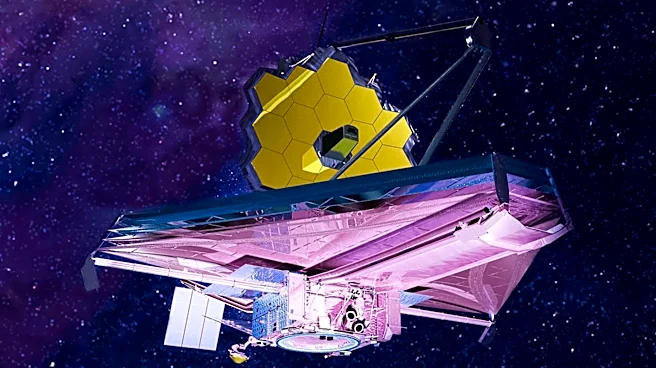
Astronomers have identified a new object from the early universe using data from the James Webb Space Telescope (JWST). The discovery was made by Homer Dávila Gutierrez, who found a gravitational arc candidate, designated A1, in the galaxy cluster MACS
J0308.9+2645. This object, characterized by its elongated and curved morphology, was identified through the phenomenon of gravitational lensing, where massive objects bend light from more distant sources. A1 is notable for its geometry, brightness, and absence from existing catalogs, suggesting it is a previously unrecorded object from when the universe was very young.
Why It's Important?
This discovery highlights the capabilities of the JWST in providing unprecedented insights into the early universe. By identifying objects like A1, astronomers can better understand the formation and evolution of galaxies shortly after the Big Bang. The findings also demonstrate the potential for further discoveries using existing data, encouraging continued exploration and analysis. Such research can significantly advance our knowledge of cosmic history and the fundamental processes that shaped the universe.
What's Next?
Further analysis and follow-up observations are needed to confirm the nature and characteristics of A1. Researchers will likely continue to explore the JWST's data for additional early universe objects, potentially leading to more groundbreaking discoveries. Collaboration between independent researchers and program teams will be essential in verifying findings and refining models of the universe's early stages. The ongoing study of gravitational lensing and its applications in astronomy will remain a key focus for future research.