


What's Happening?
Camilla Parker Bowles did not attend Princess Diana's funeral in 1997, a decision rooted in strict adherence to royal protocol. As the wife of the heir apparent, Diana's position as the Prince of Wales's spouse during the funeral rites meant that Camilla's
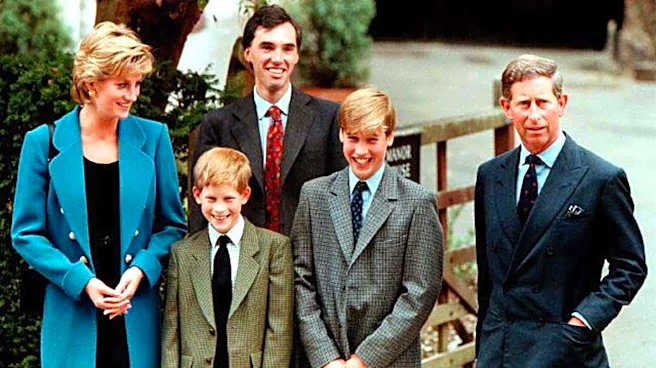
presence at the formal service would have been deemed inappropriate and confusing. A senior royal aide at the time confirmed that there was never any question of Camilla attending the funeral, emphasizing that the event was for Diana, the Prince's wife. This protocol was communicated to the couple, and Camilla understood her role, choosing to maintain public silence to protect the Prince and navigate the complexities of royal public life. While she was absent from the formal services at Westminster Abbey and St. George's Chapel, Camilla did join Prince Charles, his sons William and Harry, and other close family members at a private wake held at Buckingham Palace.
Why It's Important?
This adherence to royal protocol highlights the rigid and often impersonal nature of institutional traditions within the British monarchy, even in moments of profound national grief. Camilla's absence from the public funeral, despite her significant personal relationship with Prince Charles, underscores the primacy of established rules over individual circumstances. This event shaped public perception of Camilla for years, contributing to the narrative surrounding her role in the royal family. It also demonstrates the immense pressure on royal figures to conform to expectations, even when those expectations are emotionally challenging. The distinction between public and private mourning, with Camilla attending the private wake but not the public funeral, illustrates the careful management of royal image and the boundaries imposed by tradition.
What's Next?
The public narrative surrounding Camilla's role has significantly evolved since Diana's death, particularly with her eventual marriage to Prince Charles and her acceptance as Queen Consort. This historical event serves as a benchmark for understanding the challenges and transformations within the monarchy. While the immediate aftermath of Diana's funeral saw intense public scrutiny, the long-term trajectory has been one of gradual normalization and acceptance for Camilla. Future royal events and public appearances will continue to reflect this evolved understanding of her role, moving further away from the controversies of the past. The incident also provides a case study for how royal protocols are navigated and, at times, adapted or reinterpreted over time to accommodate changing societal views and personal relationships within the institution.
Beyond the Headlines
The decision for Camilla to not attend Diana's funeral delves into the deeper ethical and cultural dimensions of royal duty versus personal relationships. It reveals the sacrifices individuals within the monarchy are expected to make for the sake of institutional stability and public perception. The 'strict adherence to royal protocol' can be seen as a mechanism to maintain order and tradition, but it also highlights the emotional toll on those involved. This event contributed to a broader public discourse about the humanity of the royal family and the often-conflicting demands placed upon them. It also underscores the power of public opinion and media scrutiny in shaping royal narratives, and how the monarchy strategically manages its image in times of crisis and transition.