


What's Happening?
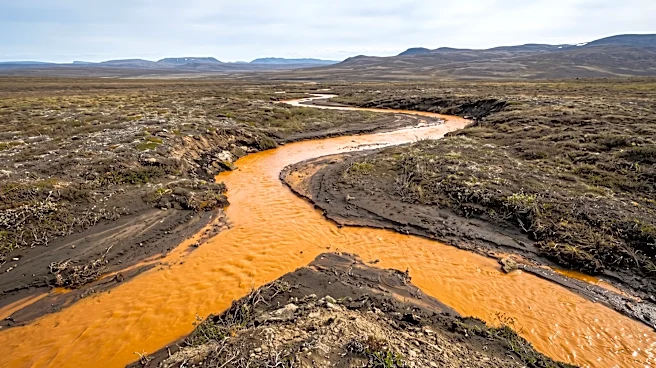
Mike Carey, a research fish biologist with the United States Geological Survey, observed a significant environmental change in remote northern Alaskan streams. In 2017, he surveyed a stream with thriving aquatic life, but upon returning in 2018, he found
the same stream had turned entirely orange, with no fish remaining. This phenomenon, along with over 70 similar cases documented across remote parts of Alaska by researchers from the United States Geological Survey, the National Park Service, and the University of California, Davis, is attributed to climate-driven permafrost degradation. The thawing permafrost allows liquid water to penetrate deep into the earth, leading to a chemical reaction known as acid rock drainage, which releases sulfuric acid and dissolved minerals, turning the water orange.
Why It's Important?
The transformation of Alaskan rivers from clear to orange due to permafrost thaw represents a critical environmental issue with far-reaching implications for the U.S. and global ecosystems. The loss of aquatic life, as observed by Mike Carey, indicates a direct impact on biodiversity and the delicate balance of northern ecosystems. While larger river systems have shown a natural buffering capacity against increased acidity, the elevated levels of metals traveling downstream pose a long-term threat to coastal estuaries and potentially to the food chain. This phenomenon highlights the tangible consequences of climate change, particularly in the Arctic, which is warming at an accelerated rate, affecting indigenous communities, wildlife, and potentially broader climate patterns.
What's Next?
Ongoing research, such as the follow-up investigation monitoring six Alaskan watersheds from 2022 to 2024, aims to trace the downstream fate of mobilized metals and understand the full extent of this environmental change. Scientists will continue to assess the long-term impacts on aquatic ecosystems, wildlife, and potential implications for human populations, although immediate drinking water contamination has not been observed. The findings will likely inform future climate change mitigation strategies and conservation efforts in the Arctic. Further studies may also explore the economic impacts on fishing industries and tourism, as well as the broader ecological consequences of widespread permafrost thaw.
Beyond the Headlines
The orange rivers in Alaska serve as a stark visual indicator of the profound and often unexpected ways climate change is altering natural landscapes. This development goes beyond simple temperature increases, revealing complex geochemical processes triggered by permafrost thaw. It underscores the interconnectedness of environmental systems, where changes in one area, like permafrost, can have cascading effects on water quality, aquatic life, and potentially human health. The situation also raises ethical questions about humanity's role in accelerating these changes and the responsibility to protect vulnerable ecosystems and communities from their consequences.