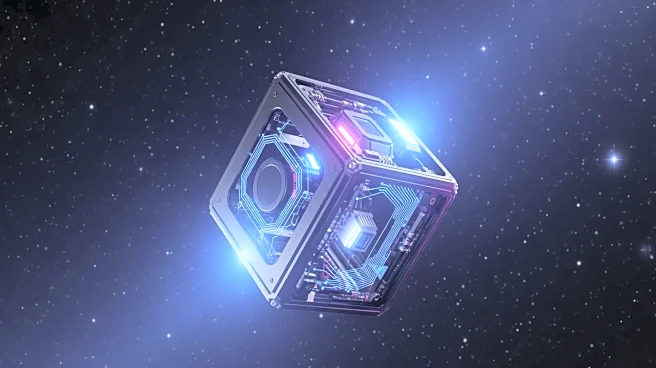

What's Happening?
The University of Delaware has developed a groundbreaking device called CosmicWatch, which allows for the detection of muons, a type of space particle, in a compact and affordable form. Created by physics
professor Spencer Axani, the device is about the size of a box of animal crackers and costs around $100 to produce. It lights up and counts each time a muon passes through it, storing the data for analysis. Originally designed as an educational tool, CosmicWatch is now used in international astrophysics experiments. The device has been upgraded to withstand high radiation levels and collect data faster, making it suitable for large-scale detectors and experiments. It is also being used in educational settings to teach students about particle physics, providing hands-on experience in building and using the detectors.
Why It's Important?
CosmicWatch represents a significant advancement in making particle physics accessible and affordable. By reducing the cost and size of muon detectors, it opens up new possibilities for educational institutions and research facilities that previously could not afford such technology. This democratization of science allows more students and researchers to engage in real-world physics experiments, potentially inspiring the next generation of scientists. Additionally, the device's application in international experiments contributes to our understanding of cosmic phenomena and could lead to new discoveries in astrophysics. The ability to monitor muon rates globally could also enhance our understanding of environmental changes and cosmic events.
What's Next?
The future of CosmicWatch includes expanding its use in educational and research settings worldwide. There is potential for a global 'citizen science' project where individuals can monitor muon rates and share data online. Additionally, an offshoot of the device is being developed to enhance satellite communication, allowing satellites to respond to environmental changes such as solar flares. This could improve satellite safety and functionality. As the device continues to evolve, it may find applications in other areas of physics and technology, further broadening its impact.