
What's Happening?
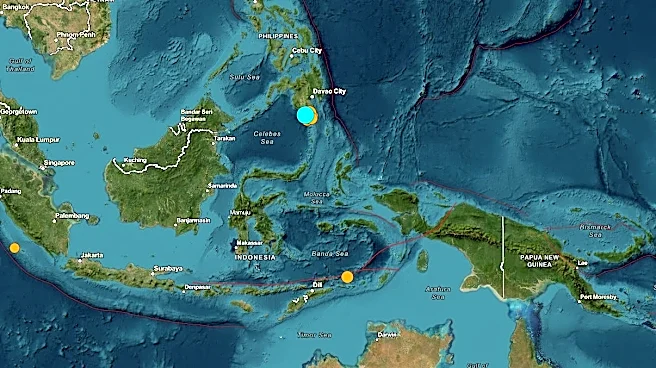
A powerful earthquake has struck the southern Philippines, prompting immediate tsunami warnings and evacuations. The earthquake occurred at 07:37 local time, with varying reports on its magnitude and depth.
The Philippine Institute of Volcanology and Seismology reported a magnitude of 7.0 at a depth of 10km, while the US Geological Survey and the German Research Centre for Geosciences recorded it as 7.8 with depths of 35km and 50km, respectively. In response, several countries, including the Philippines, Indonesia, and Japan, have issued tsunami warnings. Filipino authorities have ordered evacuations in coastal areas, and there are reports of power and communication outages in the coastal province of Sarangani, near the quake's epicenter.
Why It's Important?
The earthquake's impact is significant due to the potential for widespread damage and loss of life, particularly in coastal regions vulnerable to tsunamis. The immediate response by local and international authorities highlights the urgency and seriousness of the situation. The event underscores the importance of disaster preparedness and the need for effective communication and evacuation strategies in earthquake-prone regions. The economic and social implications could be substantial, affecting infrastructure, local economies, and the well-being of affected communities.
What's Next?
Authorities in the affected regions are likely to continue monitoring the situation closely, with further updates expected as more information becomes available. Emergency services will be focused on ensuring the safety of residents and assessing the damage. International aid and support may be mobilized if the situation escalates. The effectiveness of the response will be critical in mitigating the impact of the disaster.