






What's Happening?
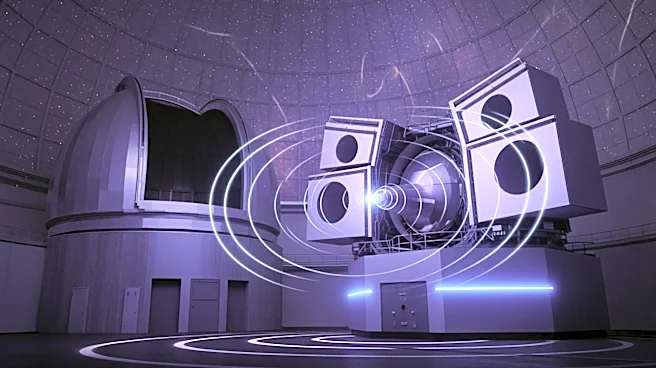
Researchers are investigating the possibility of detecting dark matter by analyzing gravitational waves produced when black holes merge. Dark matter, which does not interact with light, remains one of the universe's most elusive components. The new study
suggests that if two black holes collide in a region dense with dark matter, the resulting gravitational waves could carry a detectable imprint of this mysterious substance. This approach could provide a novel method to study dark matter, which outweighs ordinary matter by a significant margin. The research team has developed a method to predict the shape of gravitational waves as they pass through dark matter, potentially allowing instruments like LIGO to detect these imprints.
Why It's Important?
This research could revolutionize our understanding of dark matter, a critical component of the universe that influences the formation and behavior of galaxies. By potentially identifying dark matter through gravitational waves, scientists could gain insights into its properties and distribution. This method offers a new avenue for exploration beyond traditional particle physics approaches, which have yet to yield definitive results. The ability to detect dark matter in this way could lead to breakthroughs in cosmology and fundamental physics, impacting theories about the universe's composition and evolution.
What's Next?
As gravitational wave detectors like LIGO continue to improve in sensitivity, the likelihood of detecting dark matter imprints increases. Future research will focus on refining detection methods and analyzing more data from black hole mergers. If successful, this approach could guide the development of new technologies and experiments aimed at directly observing dark matter. The scientific community will likely engage in further studies to validate these findings and explore their implications for our understanding of the universe.