



What's Happening?
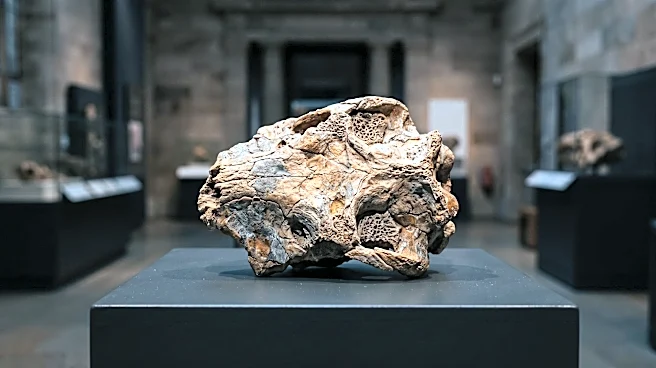
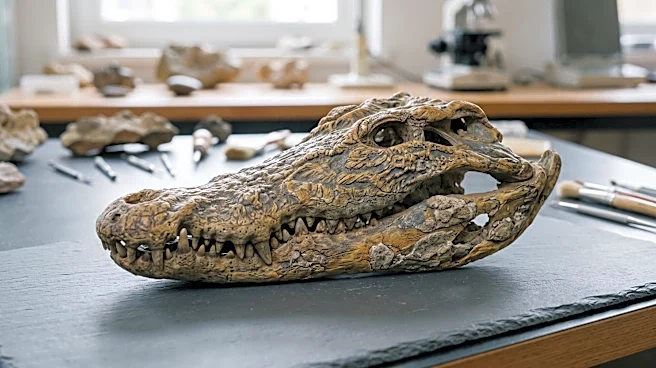
Researchers have identified a new species of extinct crocodile, named Herugavialis cairensis, from fossils found in the same limestone rocks used to carve the Great Sphinx of Giza in northeastern Egypt. These fossils, including a nearly complete skull,
were initially collected in the 1920s and mistakenly identified as belonging to the living Tomistoma species. However, through the use of CT scanning, a research team led by Paul Burke, a former PhD student, identified several anatomical differences, such as raised rims around the eye sockets, distinguishing it as a unique species. The Mokattam Formation, where the fossils were found, formed 45 million years ago in a shallow marine environment when sea levels were higher.
Why It's Important?
This discovery is important for understanding the evolutionary history and global distribution of gavial crocodiles. It challenges previous assumptions about the species' lineage and highlights the diversity of ancient crocodilians, many of which were capable of living in marine environments, unlike their modern freshwater-restricted counterparts. The finding provides crucial insights into how these animals adapted to varying sea levels and environmental conditions over millions of years. Furthermore, the study underscores the value of re-examining historical fossil collections with modern technology, revealing new information that can reshape our understanding of prehistoric life and the impact of past climate events on biodiversity.
What's Next?
The discovery of Herugavialis cairensis opens new avenues for research into the paleontology of gavials and other ancient crocodilians. Researchers will likely continue to re-examine other historically described species from Africa and Europe using advanced imaging techniques like CT scanning to uncover more hidden diversity. This could lead to a more accurate phylogenetic tree for gavials and a better understanding of their dispersal mechanisms across ancient oceans. Further studies may also focus on the environmental conditions of the Mokattam Formation to gain deeper insights into the marine ecosystems of 45 million years ago and how these ancient species adapted to such environments.
Beyond the Headlines
The naming of Herugavialis cairensis, with its nod to the Sphinx and the Egyptian god Heru, connects ancient paleontology with cultural heritage, offering a unique blend of scientific and historical narrative. This discovery also serves as a powerful reminder of the long-term impacts of climate change and environmental shifts on biodiversity. The Messinian salinity crisis, which led to the disappearance of crocodiles from the Mediterranean, illustrates how rapid and extreme changes in temperature and sea level can have lasting consequences on ecosystems, spanning millions of years. This historical context provides a critical perspective on the potential effects of current climate emergencies on modern species and ecosystems.