


What's Happening?
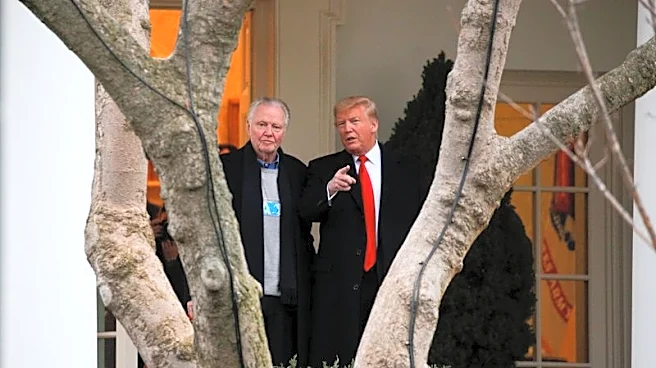
President Trump recently took to social media to strongly criticize the growing national movement against data centers, warning that communities rejecting them risk economic stagnation. In a post on Truth Social, President Trump argued that embracing
data centers leads to prosperity, lower taxes, and job creation, while opposition could result in communities becoming 'backwards and poor.' He also suggested that foreign competitors, such as China, would welcome domestic resistance to data center development. This statement comes amidst increasing opposition in West Virginia, where residents and state agencies are pushing back against the extensive utility infrastructure required to power large-scale data centers, particularly those serving out-of-state interests. Concerns include local utility customers potentially subsidizing massive power lines and environmental impacts from associated power plants.
Why It's Important?
President Trump's intervention highlights the national economic and political dimensions of data center development, framing it as a critical component of modern prosperity. His comments underscore the tension between local environmental and community concerns and broader economic development goals. In West Virginia, this debate is particularly acute, with state agencies and citizens actively challenging projects like NextEra’s MARL transmission line and a proposed gas-and-diesel power plant for a data center in Tucker County. The conflict reveals a significant policy challenge: how to balance the economic benefits of technological infrastructure with the protection of local environments and the financial interests of ratepayers. The outcome of these local disputes, influenced by national political rhetoric, could set precedents for future infrastructure projects across the country.
What's Next?
The debate over data center development and its associated infrastructure is expected to intensify, with President Trump's comments potentially galvanizing proponents while further entrenching opposition. In West Virginia, local resistance is likely to continue, with ongoing legal challenges and public protests against projects like the MARL transmission line and the Tucker County data center. State leadership, including Governor Patrick Morrisey, is attempting to navigate this complex issue by proposing a '20-Year Responsible Data Center Development Plan.' This plan aims to secure economic benefits while legally protecting local ratepayers from bearing construction and energy costs. The future will likely involve continued legal battles, policy adjustments, and public discourse as states and communities grapple with the economic and environmental trade-offs of large-scale data infrastructure.
Beyond the Headlines
The controversy surrounding data centers extends beyond immediate economic and environmental concerns, touching upon broader issues of energy policy, technological advancement, and community autonomy. The immense power demands of data centers raise questions about the sustainability of energy grids and the reliance on fossil fuels, even as the digital economy expands. The 'anti-data center movement' reflects a growing public awareness of the hidden costs of technological progress, including environmental degradation and the potential for local communities to bear the brunt of infrastructure development without fully realizing the benefits. This situation also highlights the challenge of reconciling national economic imperatives with local democratic processes and environmental justice, prompting a reevaluation of how large-scale industrial projects are planned, approved, and integrated into existing communities.