


What's Happening?
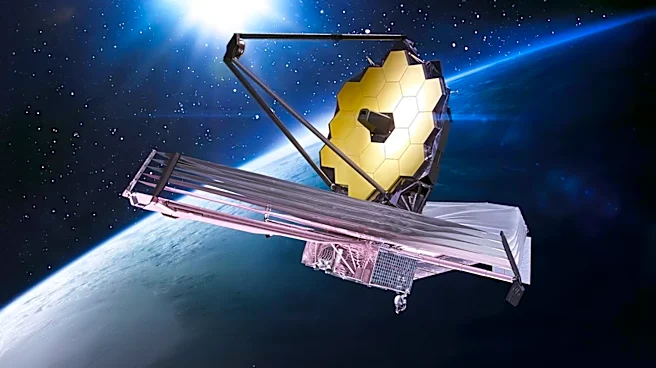
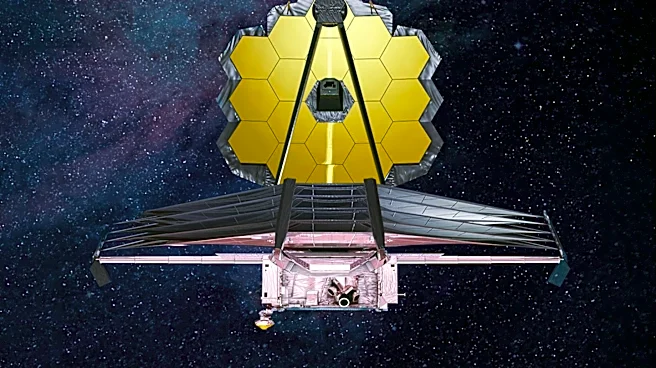
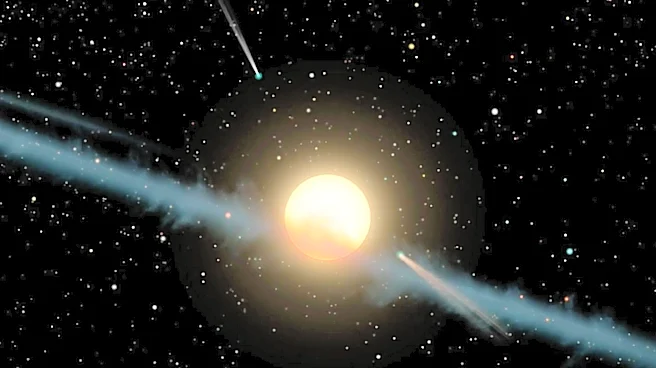
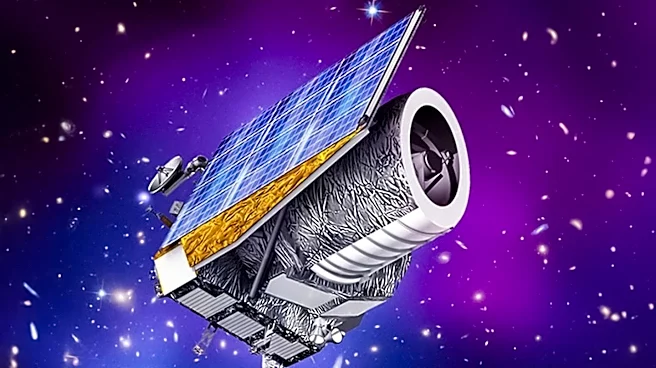
The Hubble Space Telescope (HST), specifically its STIS instrument, has detected the 'Cat's Tail' around the star Beta Pictoris in scattered light. This finding is part of a study published on October 7, 2026, which analyzed six HST/STIS observing epochs
from 2012 through 2025. The study combined Hubble's measurements with data from the James Webb Space Telescope (JWST/MIRI) to model the dust composition. The HST/STIS captured starlight scattered by dust in the 'Cat's Tail,' with a significant signal-to-noise ratio across much of the disk's midplane. The disk was detected to a projected separation of 500 astronomical units (AU). The analysis indicates that the dust grains are highly porous particles, almost entirely composed of organic refractory material. Researchers propose that the 'Cat's Tail' likely originated from a collision between large bodies.
Why It's Important?
This discovery significantly advances our understanding of protoplanetary disks and the early stages of planetary system formation. By identifying the composition of the dust in the 'Cat's Tail' as highly porous organic refractory material, scientists gain crucial insights into the building blocks available for planet formation in other star systems. The use of both Hubble and James Webb Space Telescope data highlights the complementary nature of different observational wavelengths, providing a more comprehensive view of cosmic phenomena. This research contributes to the broader field of exoplanet studies, helping to explain how debris disks evolve and potentially lead to the creation of planets. Understanding these processes around stars like Beta Pictoris can offer clues about the formation history of our own solar system.
What's Next?
Future research will likely focus on refining the models of the dust grains and their origins, potentially seeking direct observational evidence of the proposed parent bodies. The ongoing collaboration between the Hubble Space Telescope and the James Webb Space Telescope will continue to provide valuable multi-wavelength data, allowing for more detailed analyses of other debris disks and star-forming regions. Scientists will also continue to investigate the prominent warp and surface-brightness asymmetry in Beta Pictoris’s outer dust halo, exploring the role of planet-disk interactions, such as the gravitational influence of Beta Pic b, in shaping these structures. These efforts will further enhance our understanding of the dynamics and evolution of young stellar systems.
Beyond the Headlines
The detection of complex organic refractory material in the 'Cat's Tail' has profound implications for astrobiology and the potential for life beyond Earth. Organic refractory materials are crucial components in the formation of comets and asteroids, which are believed to have delivered water and organic molecules to early Earth. The presence of such materials in a young star system like Beta Pictoris suggests that the necessary ingredients for life may be common throughout the galaxy. This finding reinforces the idea that the universe is rich in the chemical precursors to life, encouraging further exploration into the prevalence of habitable environments and the origins of life itself. It underscores the interconnectedness of cosmic processes and the potential for life to emerge in diverse stellar environments.