






What's Happening?
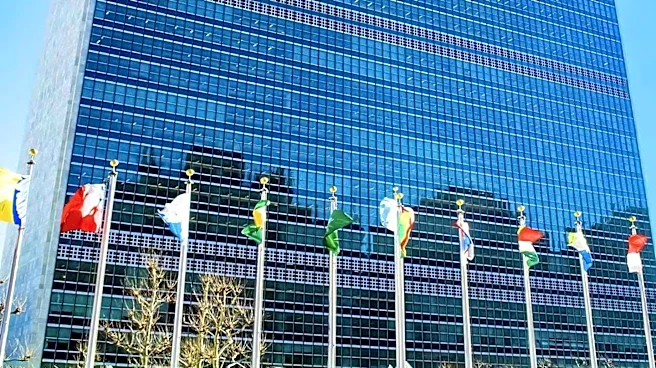
The United Nations and the International Committee of the Red Cross (ICRC) have intensified their joint call for countries to adopt bans and restrictions on the use of autonomous weapons systems, often referred to as 'killer robots.' This renewed appeal,
building on efforts from three years ago and ongoing international discussions, emphasizes that the risks associated with these weapons have significantly increased. While not advocating for a complete ban, the organizations highlight that such systems are under development, though their use on battlefields remains unconfirmed by the UN and ICRC. UN Secretary-General António Guterres and ICRC President Mirjana Spoljaric issued a joint statement warning that the world is 'dangerously close to crossing a moral red line: The autonomous targeting of humans by machines.' They stress the need to protect civilians as the development of weapons technology progresses at 'record speed,' creating a widening gap between technological capabilities and regulatory frameworks. Negotiators are scheduled to meet in Geneva in November to discuss strengthening the Convention on Conventional Weapons, which the UN and ICRC view as the most viable path toward legally binding rules for autonomous systems.
Why It's Important?
The push for international rules on autonomous weapons systems is critical due to the profound ethical, legal, and humanitarian implications of machines making life-and-death decisions without human intervention. The rapid advancement of artificial intelligence and robotics means that these systems are no longer a distant future concept, but an imminent reality. Without clear international regulations, there is a significant risk of an arms race in autonomous weapons, leading to unpredictable consequences and potentially lowering the threshold for conflict. The lack of human oversight in targeting could result in violations of international humanitarian law, particularly concerning the distinction between combatants and non-combatants, and the principle of proportionality. This issue affects global security, as the proliferation of such weapons could destabilize international relations and create new challenges for arms control and disarmament. The involvement of the UN and ICRC underscores the humanitarian imperative to address this technological frontier before its potential negative impacts become irreversible.
What's Next?
The upcoming conference in Geneva in November will be a crucial forum for countries to discuss and potentially agree upon legally binding rules for autonomous weapons systems. The UN and ICRC are urging states to make this year a 'turning point' in regulating these technologies. Key stakeholders, including governments, military strategists, ethicists, and technology developers, will need to engage in complex negotiations to define what constitutes 'human oversight' and what types of autonomous functions should be restricted or banned. The debate will likely involve balancing national security interests with humanitarian concerns. The outcome of these discussions could range from a comprehensive ban on certain types of autonomous weapons to the establishment of strict regulatory frameworks and accountability mechanisms. The ongoing use of drones and other advanced technologies in conflicts, such as the Russia-Ukraine war, will likely influence the urgency and direction of these international efforts.
Beyond the Headlines
The debate over autonomous weapons systems extends beyond immediate battlefield concerns to fundamental questions about human agency, morality, and the future of warfare. Allowing machines to autonomously select and engage targets challenges the very essence of human dignity and responsibility. It raises the specter of a future where ethical decisions in conflict are outsourced to algorithms, potentially leading to a dehumanization of warfare and a diminished capacity for empathy. The 'moral red line' mentioned by the UN and ICRC highlights a deep-seated concern that such technology could fundamentally alter the nature of human conflict, making it more abstract, less accountable, and potentially more devastating. Furthermore, the development of these systems could exacerbate global inequalities, as only technologically advanced nations might possess them, creating new power imbalances. The call for regulation is not just about preventing harm, but about preserving human control over the most critical decisions in society and ensuring that technology serves humanity, rather than dictating its fate.