




What's Happening?
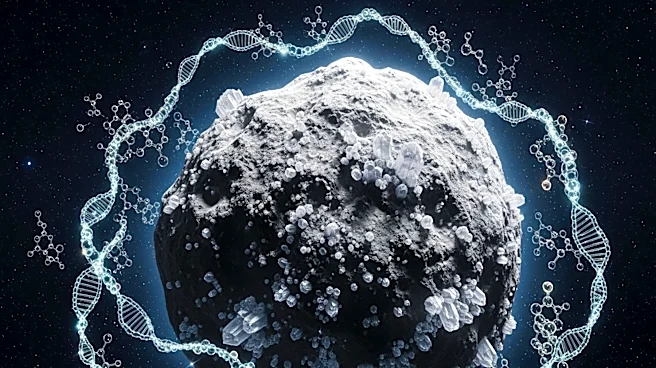
A recent study has identified all five nucleobases, the chemical components of DNA and RNA, in samples from asteroid Ryugu. The Japan Aerospace Exploration Agency's Hayabusa2 spacecraft collected these samples and returned them to Earth in 2020. This
discovery supports the hypothesis that essential molecules for life could form in space and be widespread in primitive asteroid materials. The study, led by Toshiki Koga, suggests that these molecules were present in the early solar system, potentially seeding Earth with the ingredients for life.
Why It's Important?
The identification of nucleobases in asteroid Ryugu is a significant advancement in understanding the origins of life. It suggests that the building blocks of life could be common in the cosmos, supporting theories that life on Earth may have been seeded by extraterrestrial materials. This finding has profound implications for astrobiology, as it indicates that similar processes could occur on other planets, potentially leading to life elsewhere in the universe. The study reinforces the idea that the components necessary for life were present in the solar nebula, offering insights into the conditions that led to the emergence of life on Earth.
What's Next?
Further analysis of the Ryugu samples and similar asteroids could provide more detailed insights into the chemical processes that occur in space. Researchers may focus on understanding how these molecules interact and evolve, potentially leading to the formation of more complex organic compounds. The findings could also guide future space missions aimed at collecting samples from other celestial bodies, expanding our knowledge of the distribution of life's building blocks in the universe.