







What's Happening?
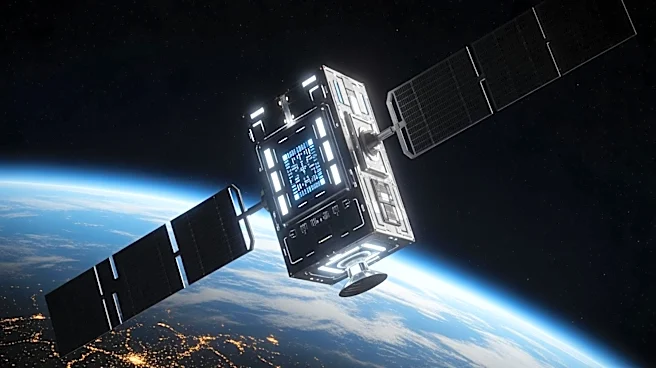
Swiss startup DPhi Space has successfully demonstrated in-space compute capabilities by hosting Liquid AI's large language model to analyze an Earth observation (EO) image directly in orbit. This was achieved during DPhi's second mission, Clustergate-2,
which launched on a Momentus Vigoride 7 satellite. The mission marks a significant step in space-compute technology, allowing engineers to upload and test software in space without deploying their own satellites. The demonstration involved the AI model describing an image captured by an onboard camera, showcasing DPhi's ability to operate a compute platform in orbit.
Why It's Important?
This development represents a breakthrough in space technology, enabling more efficient data processing and analysis directly in orbit. By reducing the need to transmit data back to Earth, in-space compute capabilities can enhance the speed and efficiency of satellite operations. This technology could revolutionize various applications, including real-time data analysis for Earth observation, space exploration, and satellite communications. DPhi's success also lowers the barriers for developers to test and deploy software in space, potentially accelerating innovation in the space industry.
What's Next?
DPhi plans to integrate lessons from Clustergate-1 and -2 into a new production-class satellite, OmniSat, designed to host both payloads and software capabilities. OmniSat is expected to launch by late 2027, featuring hosted sensors and NVIDIA GPUs. The company is also engaging developers through hackathons to explore new use cases for in-space compute power, aiming to expand its customer base. As the technology matures, it could lead to more widespread adoption of in-space computing, transforming how satellite data is processed and utilized.