




What's Happening?
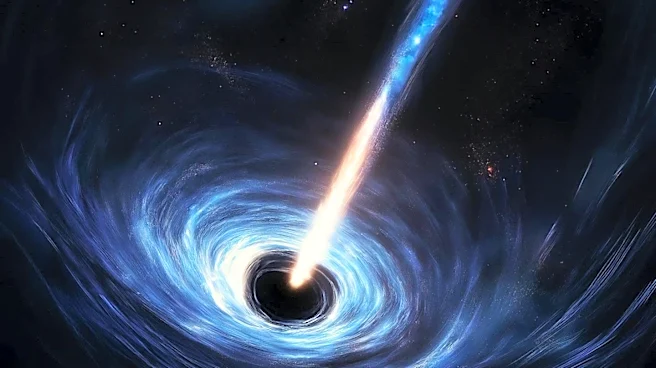
Astronomers have successfully reconstructed a continuous, high-resolution video of a relativistic outflow from a black hole, providing unprecedented detail into plasma motion within its jet. This achievement was made possible by compiling 116 Very Long
Baseline Array (VLBA) observations collected over 27 years. Researchers developed a new imaging framework called 'kine,' which uses neural fields to reconstruct continuous radio videos from sparse interferometric data. This technique allows for the measurement of the continuous physical flow of plasma, moving beyond previous methods that only tracked isolated emission features. The study, published in Nature, applied this method to the blazar 3C 345, reconstructing all observational epochs simultaneously and recovering fine-scale kinematics across both space and time. This advancement offers a more comprehensive understanding of how magnetized flows transport energy, which is crucial for broader astrophysics.
Why It's Important?
This breakthrough in astronomical imaging is significant because it provides a more accurate and continuous view of plasma dynamics in black hole jets. Previous methods often relied on tracking discrete, bright features, which could obscure the underlying continuous flow of plasma. By enabling direct measurement of the instantaneous velocity field across the jet, this research offers a deeper insight into the fundamental processes governing active galactic nuclei. Understanding these processes is vital for comprehending how energetic phenomena shape cosmic environments and how black holes influence their surroundings. The improved resolution and dynamic range achieved by the 'kine' framework represent a substantial leap in observational capabilities, allowing scientists to characterize bulk flow even in faint regions that lack defined brightness peaks. This could lead to a re-evaluation of existing models for black hole jets and their impact on galactic evolution.
What's Next?
The development of the 'kine' imaging framework is expected to provide an observational foundation for evaluating whether observed features in black hole jets behave as standard shock waves or reflect other plasma dynamics. Future research will likely involve applying this technique to other blazars and active galactic nuclei to further refine our understanding of relativistic jets. The ability to track persistent polarization patterns along the jet and observe how magnetic topologies evolve downstream when new emission features emerge from the core will be critical. This continuous, high-resolution imaging could lead to new discoveries about the mechanisms driving these powerful cosmic phenomena and their role in the universe. The technique's ability to separate the motion of underlying plasma from moving brightness patterns will allow for more precise testing of theoretical models.
Beyond the Headlines
The implications of this research extend beyond merely observing black hole jets; it represents a significant advancement in how astronomers can interpret complex astrophysical data. The use of neural fields to reconstruct continuous videos from sparse interferometric data highlights the growing role of artificial intelligence and advanced computational methods in scientific discovery. This approach could be adapted for other areas of astronomy where continuous, high-resolution imaging is challenging, potentially revolutionizing our understanding of dynamic cosmic events. Furthermore, the study's findings contribute to the broader effort to untangle dark matter from galactic feedback, demonstrating the interconnectedness of various energetic phenomena in shaping cosmic environments. This continuous video reconstruction offers a more holistic view of these extreme cosmic engines, potentially revealing previously unseen behaviors and interactions.