



What's Happening?
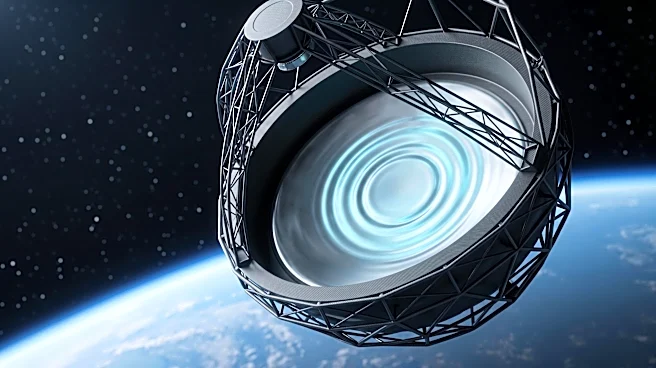
New research details a method for thermocapillary stabilization of liquid space telescopes. The study focuses on a system where a thin liquid layer coats the inside of a spherical frame, with the layer's thickness pinned at the outer edge. A spatially
uniform, time-modulated heat flux is applied at the solid-liquid interface, creating thermocapillary stresses on the liquid layer's free surface. This heating alternates between an 'on-period' with a specific magnitude and duration, and an 'off-period' where the boundary is insulating. During off-periods, radiation cools the mirror surface, with thinner regions cooling faster. This process generates stabilizing oscillations, drawing fluid to thinner regions and significantly reducing thermocapillary instability caused by heating. The research utilizes non-dimensionalized governing equations and analyzes the system's dynamics through various parameters, including the scaled inverse Prandtl number, scaled inverse capillary number, scaled Marangoni number, radiation parameter, and the ratio between background and mirror surface radiation. The study also examines the long-term evolution of the system through multiple scale analysis and linear stability analysis.
Why It's Important?
This research is important for the advancement of space exploration and astronomical observation. Liquid space telescopes offer potential advantages in terms of cost and size for creating large, high-resolution mirrors in space. However, maintaining the precise shape of a liquid mirror in a microgravity environment is challenging due to thermocapillary instabilities, which can distort the liquid surface. The proposed thermocapillary stabilization method, by actively managing heat flux and leveraging radiative cooling, provides a mechanism to counteract these instabilities. This could enable the development of larger and more stable liquid mirrors, leading to more powerful space telescopes capable of observing distant celestial objects with unprecedented clarity. The ability to stabilize these mirrors could significantly impact fields like astrophysics and cosmology, allowing for new discoveries and a deeper understanding of the universe. Successful implementation of this technology could also reduce the complexity and cost associated with manufacturing and deploying traditional solid-mirror telescopes in space.
What's Next?
The research outlines a theoretical framework for thermocapillary stabilization, and the next steps would likely involve experimental validation of these principles. This could include developing prototypes of liquid mirrors in controlled laboratory environments to test the effectiveness of the proposed heating cycles and radiative cooling mechanisms. Further studies would be needed to optimize the parameters, such as heating magnitude, duration, and cycle time, to achieve maximum stabilization for different liquid mirror configurations and sizes. Additionally, engineers would need to consider the practical challenges of implementing such a system in a space environment, including power requirements, thermal management, and long-term reliability. Future research might also explore the integration of this stabilization technique with other active or passive control methods to further enhance the performance and stability of liquid space telescopes. The development of these technologies could pave the way for future missions utilizing liquid mirrors for advanced astronomical observations.
Beyond the Headlines
The development of stable liquid space telescopes has profound implications beyond immediate scientific discovery. It represents a paradigm shift in how large-scale optical systems can be constructed in space, potentially democratizing access to advanced astronomical capabilities by reducing manufacturing and launch costs. This could foster greater international collaboration in space science and open new avenues for research that are currently limited by the size and cost of conventional telescopes. Furthermore, the principles of thermocapillary stabilization explored in this research could find applications in other areas of fluid dynamics and materials science, particularly in microgravity environments or for precision manufacturing processes on Earth. The ability to precisely control liquid surfaces through thermal gradients could lead to innovations in fields such as microfluidics, advanced optics, and even in the development of new materials with tailored surface properties. This research highlights the interdisciplinary nature of scientific advancement, where solutions to one complex problem can yield benefits across multiple domains.