







What's Happening?
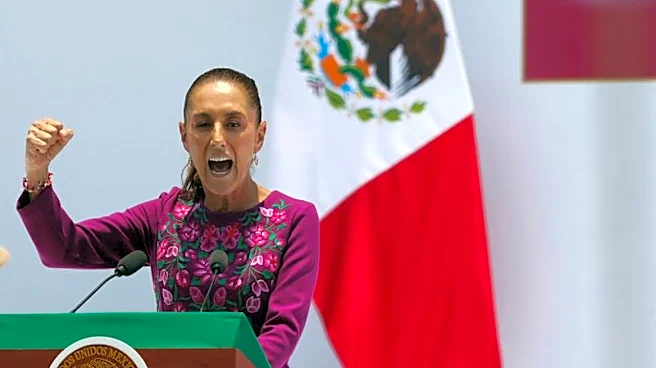
Mexico is advancing towards a universal healthcare system under President Claudia Sheinbaum's administration. The initiative, known as the Servicio Universal de Salud (SUS), aims to integrate the services of the Mexican Social Security Institute (IMSS),
the Institute for Social Security and Services for State Workers (ISSSTE), and IMSS-Bienestar. This integration seeks to provide healthcare access to 120 million Mexican citizens, allowing them to receive medical benefits across the entire system regardless of their employment status. The plan is inspired by Brazil's Sistema Único de Saúde, which is known for its comprehensive and equitable healthcare services. The initiative is structured in stages, with the first focusing on treating high-risk conditions and ensuring continuity of care for chronic diseases. The second stage will expand specialized services, and the third will universalize prescriptions and primary care for chronic diseases.
Why It's Important?
The move towards a universal healthcare system in Mexico represents a significant shift from previous policies that leaned towards privatization. By centralizing healthcare services, the initiative aims to overcome historical fragmentation and ensure equitable access to medical care. This could lead to improved health outcomes and reduced healthcare disparities across the country. The integration of services is expected to streamline healthcare delivery, making it more efficient and accessible. The initiative also highlights the importance of international cooperation, as seen in the collaboration with Brazil, which could serve as a model for other countries with fragmented healthcare systems. The success of this initiative could set a precedent for healthcare reforms in other nations facing similar challenges.
What's Next?
The implementation of the universal healthcare system will continue in stages, with the second stage scheduled for the second half of 2027. This stage will focus on the exchange of specialized services between institutions to speed up diagnoses and optimize resource use. The third stage, planned for 2028, will further expand universal healthcare access through standardized prescriptions and primary care. The initiative also includes the introduction of a Universal Health Service credential to register all Mexicans, facilitating access to healthcare services. As the plan progresses, it will be crucial to address challenges such as financing, inter-institutional coordination, and ensuring the availability of medical professionals, particularly in rural areas.