
What's Happening?
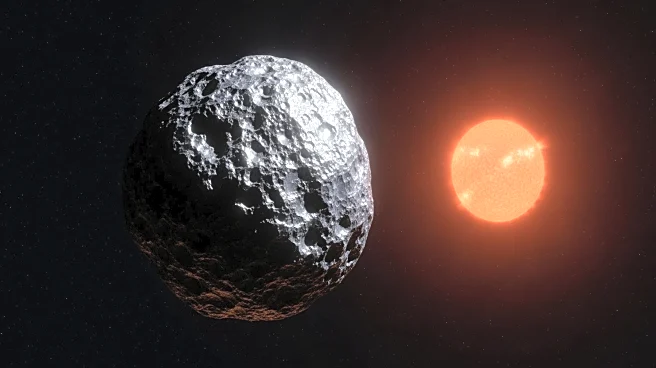
Asteroid 16 Psyche, known for its metallic composition, is currently visible in the night sky as it moves north of the bright star Aldebaran in the constellation Taurus. This celestial event provides a unique
opportunity for sky watchers to observe the asteroid, which is cataloged as Alpha Tauri. Aldebaran, a red giant star, shines at a magnitude of 0.9 and is often referred to as the Bull's eye. By 7 P.M. local time, Aldebaran is positioned 50° high in the eastern sky, following the Pleiades star cluster. Observers can use binoculars or a low-power telescope to locate Psyche, which is at a magnitude of 10.5, just 1.4° north of Aldebaran. The asteroid is currently moving westward in a retrograde motion but will change direction later in the month, offering another chance to view it in early February.
Why It's Important?
The visibility of asteroid 16 Psyche near Aldebaran presents a significant opportunity for both amateur and professional astronomers to study this unique celestial body. Psyche is of particular interest due to its metallic nature, which suggests it may be the exposed core of a protoplanet. Observing its movement and position relative to Aldebaran can provide insights into its composition and trajectory. This event also highlights the dynamic nature of our solar system and the ongoing opportunities for discovery and learning. For the general public, it serves as an engaging way to connect with astronomy and the wonders of the night sky.
What's Next?
As Psyche continues its journey across the sky, it will reach a stationary point later this month before reversing direction to move eastward. This change in motion will allow observers another chance to view the asteroid as it returns to a position north of Aldebaran in early February. Astronomers and enthusiasts are encouraged to track its progress and take advantage of this rare viewing opportunity. The event may also inspire further research and exploration missions to Psyche, contributing to our understanding of asteroid composition and the history of the solar system.