




What's Happening?
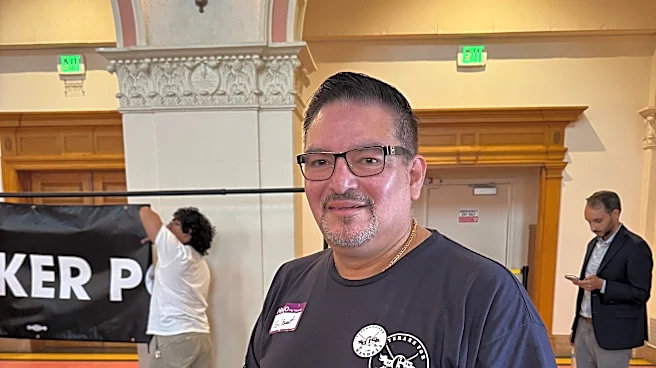
Claire Valdez, a Democratic candidate for the congressional seat in New York's 7th district, recently met with leaders of the Puerto Rican Independence Party (PIP) in Uruguay during the Pan-American Congress. The discussions focused on the political status
of Puerto Rico, as well as the island's ongoing electricity and water crises. Valdez, who won the Democratic primary on June 23, 2026, against Antonio Reynoso and Julie Won, reaffirmed her commitment to continuing the legacy of current Representative Nydia Velázquez. Her spokesperson, Ritti Singh, confirmed that Valdez supports Velázquez's Puerto Rico Self-Determination Act (H.R.2070) and intends to propose a project for a status assembly to discuss viable options for decolonization. The Pan-American Congress, held from August 21-23, 2026, aims to foster hemispheric cooperation and solidarity among nations.
Why It's Important?
This engagement highlights the growing attention within U.S. political discourse, particularly among progressive Democrats, on the unresolved political status of Puerto Rico and its humanitarian challenges. Valdez's commitment to the Puerto Rico Self-Determination Act and her intention to push for a decolonization process in Congress signal a potential shift in how the U.S. government might approach its relationship with the island. The discussions also underscore the critical issues of infrastructure (electricity and water) and healthcare funding (Medicaid fiscal cliff) that deeply affect the lives of Puerto Ricans. For the U.S., addressing these issues could have significant implications for federal spending, foreign policy, and the rights of its citizens in the territory. The involvement of Democratic Socialists of America (DSA) members further indicates a broader movement advocating for Puerto Rican independence and self-determination, potentially influencing future legislative efforts and public opinion.
What's Next?
If elected, Claire Valdez plans to introduce legislation for a status assembly to determine Puerto Rico's future, aiming for an open and democratic process for decolonization. This initiative would likely spark significant debate within Congress and among various stakeholders, including those advocating for statehood or continued commonwealth status. The DSA's public stance in favor of Puerto Rican independence and their call for the U.S. Congress to initiate a decolonization process suggests continued pressure on lawmakers. Future discussions will likely involve the economic development of Puerto Rico, debt cancellation, and the establishment of new diplomatic relations between Puerto Rico and the U.S. The outcome of these efforts could redefine the political and economic landscape for the island and its relationship with the mainland United States.
Beyond the Headlines
The discussions surrounding Puerto Rico's political status delve into profound ethical and historical dimensions of U.S. colonialism. As the oldest colony in the hemisphere, the island's unresolved status raises questions about self-determination, human rights, and the principles of democracy that the U.S. espouses globally. The emphasis on an 'open and democratic process' for decolonization reflects a growing recognition that the current territorial arrangement is unsustainable and unjust. Beyond political status, the focus on basic necessities like electricity, water, and healthcare highlights the humanitarian crisis exacerbated by the island's colonial relationship and past natural disasters. This movement for self-determination is not just about political independence but also about ensuring a dignified life for Puerto Ricans, addressing systemic inequalities, and rectifying historical injustices. The broader implications could include a re-evaluation of U.S. territorial policies and a precedent for other non-self-governing territories.