

What's Happening?
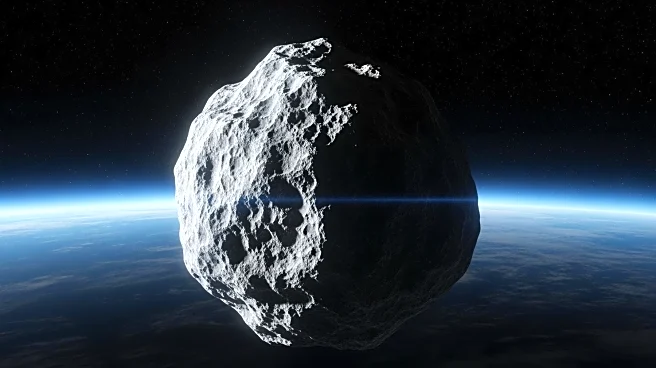
NASA is closely monitoring an asteroid, designated as '2025 XF1', which is approximately the size of a bus and is traveling towards Earth at a speed of nearly 8,000 miles per hour. According to NASA's Center for Near Earth Object Studies (CNEOS), this
asteroid is expected to pass within 195,000 miles of Earth on Saturday. In addition to 2025 XF1, NASA is also tracking another bus-sized asteroid, '2025 XK1', which will come within 624,000 miles of Earth on Friday. Furthermore, two plane-sized asteroids, '2020 WH20' and '2016 YH', are also being observed as they approach Earth at speeds of nearly 20,000 miles per hour, with their closest approaches scheduled for Friday and Saturday, respectively. These asteroids are part of a group known as 'near-Earth objects', which are celestial bodies whose orbits bring them within 120 million miles of the sun and into Earth's orbital neighborhood.
Why It's Important?
The monitoring of near-Earth objects like 2025 XF1 is crucial for planetary defense and understanding potential threats from space. While NASA assures that the majority of these objects pose no risk of impact, the agency's vigilance is essential in identifying potentially hazardous asteroids (PHAs) that could pose a threat over long periods. PHAs are defined as asteroids over 460 feet in size that come within 4.6 million miles of Earth's orbit. Although none of the currently tracked PHAs are expected to impact Earth soon, continuous observation helps refine impact probabilities and prepare for any future threats. This monitoring is vital for public safety and scientific research, as it provides insights into the behavior and characteristics of asteroids, contributing to our understanding of the solar system's formation and evolution.
What's Next?
NASA will continue to track these asteroids and update their trajectories as more data becomes available. The agency's ongoing efforts in monitoring near-Earth objects aim to improve prediction models and enhance preparedness for any potential future impacts. Public awareness and education about these celestial events are also likely to increase as NASA shares its findings. Additionally, advancements in technology and international collaboration may lead to the development of more sophisticated methods for asteroid deflection or mitigation, ensuring Earth's safety from potential asteroid impacts.