



What's Happening?
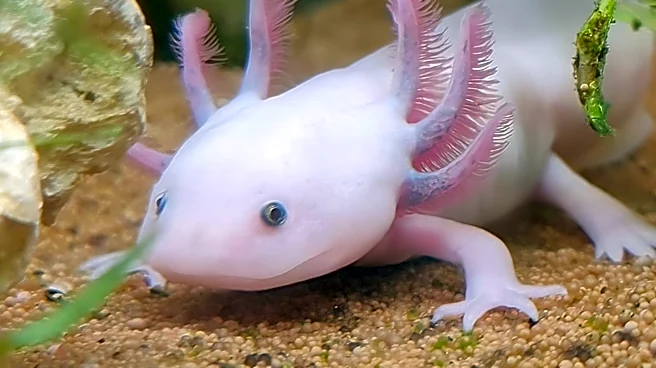
The Hands-on Science Center (HOSC) in Tullahoma has introduced a new resident, Riley, an axolotl, which is a pale, feathery-gilled aquatic salamander. Riley resides in a carefully chilled tank, captivating both children and adults. Austin Sisco, executive
director of HOSC, notes that axolotls are unique amphibians that remain in their larval stage permanently and must stay in water. Native to a single lake system in Mexico, axolotls are critically endangered in the wild but are thriving in captivity. Riley's poor eyesight necessitates food being placed directly in front of its mouth, often leading to amusing feeding reactions. The special tank maintaining Riley at 65 degrees year-round is an expensive but crucial part of its care. Riley is expected to turn one year old around January 2027, at which point its gender can be reliably identified, with an 85% chance of being male. The axolotl was named Riley in honor of a baby boy, a name chosen through a contest won by a third-grader.
Why It's Important?
The introduction of Riley the axolotl at the Hands-on Science Center is significant for several reasons. It provides a unique educational opportunity for the public, particularly children, to learn about a critically endangered species that many are familiar with through popular culture like the video game Minecraft. This exposure can foster an early interest in science and conservation among younger generations. For the community of Tullahoma, Riley has become a recognizable attraction, drawing visitors to the science center and highlighting the importance of environmental biology and species preservation. The center's commitment to maintaining Riley's specialized habitat also underscores the resources and expertise required for the care of exotic and endangered animals, potentially inspiring future scientists and conservationists. The story behind Riley's name further adds a layer of community engagement and emotional connection to the exhibit.
What's Next?
The Hands-on Science Center plans to continue using Riley as a central attraction to engage visitors and promote scientific education. Austin Sisco, the executive director, is focused on updating the center's facilities, including new paint and redesigned exhibits, to create a more vibrant space for families. Three new exhibits are scheduled to be added by the end of the year. The center encourages visitors to check its website for updates on these developments. Riley's first birthday, expected around January 2027, will be a milestone, as it will allow for a more definitive identification of its gender. The ongoing care and public display of Riley will likely continue to attract community donations and support, reinforcing the axolotl's role as a key educational asset for the center.
Beyond the Headlines
The presence of Riley the axolotl at the Hands-on Science Center extends beyond a simple exhibit, touching upon broader themes of conservation, community engagement, and the role of informal education. The axolotl's critically endangered status in the wild highlights the urgent need for conservation efforts and raises awareness about biodiversity loss. By showcasing a species that is thriving in captivity, the center provides a tangible example of successful preservation. The community's involvement, from the anonymous donor who funded Riley's acquisition to the mayor's proclamation naming it the city's official axolotl, demonstrates how local institutions can rally support for scientific and environmental causes. Furthermore, the story of Riley's naming, rooted in a child's act of remembrance, underscores the emotional and human connection to the natural world, transforming a scientific exhibit into a symbol of compassion and community spirit. This initiative exemplifies how science centers can serve as vital hubs for both education and community building.