


What's Happening?
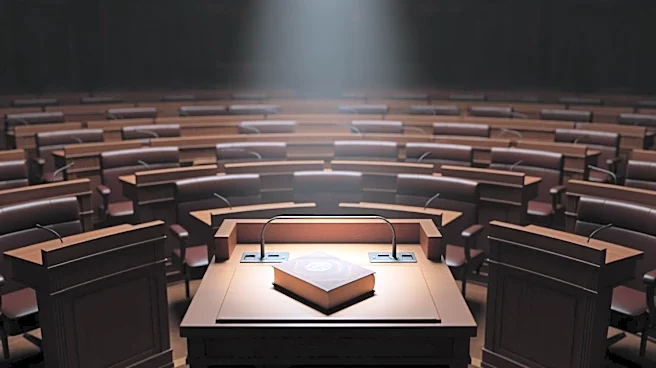
Romanian lawmakers have rejected a new government proposed by Prime Minister-designate Adrian Vestea, intensifying the country's ongoing political crisis. The vote in Parliament failed to secure the necessary 233 votes, with only 189 in favor and 23 against,
while more than half of the lawmakers abstained. This development follows a no-confidence vote that toppled the previous government in May. President Nicusor Dan had nominated Vestea, a member of the National Liberal Party (PNL), to form a government, but his proposal was not supported by his own party. The Social Democratic Party (PSD), the largest party in Parliament, backed Vestea, but the hard-right nationalist opposition party, the Alliance for the Unity of Romanians (AUR), did not. The political instability comes as Romania faces significant economic challenges, including one of the largest budget deficits in the European Union.
Why It's Important?
The rejection of Vestea's government proposal exacerbates Romania's political instability, which could have far-reaching implications for the country's economic and social landscape. With a high budget deficit and rampant inflation, the lack of a stable government could hinder efforts to address these economic issues. The ongoing political turmoil may also affect Romania's international standing and its ability to engage effectively with EU partners. The situation highlights a crisis of trust in mainstream politics, as noted by political consultant Cristian Andrei, which could lead to increased support for populist and nationalist parties like AUR. This instability could delay necessary reforms and impact Romania's economic recovery and growth.
What's Next?
President Dan will need to nominate another candidate for the premiership. If the next nominee also fails to form a government, Romania could face snap elections, although a general election is not scheduled until 2028. The ongoing political crisis may lead to further negotiations and potential shifts in party alliances as leaders seek to form a stable government. The outcome of these efforts will be crucial in determining Romania's ability to address its economic challenges and restore public trust in its political institutions.