

What's Happening?
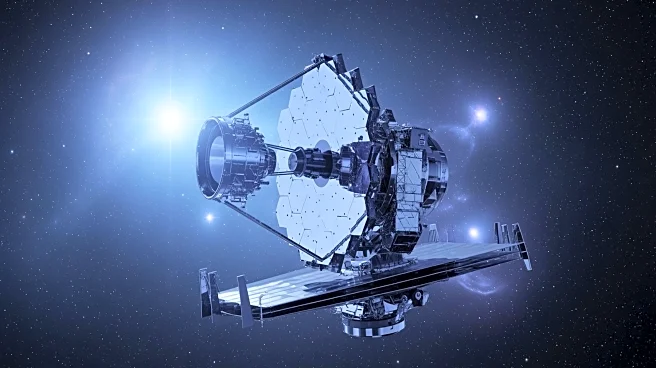
The Nancy Grace Roman Space Telescope is set to explore the epoch of reionization, a critical phase in the universe's history, through its Spectroscopic Probes of Quantitative Reionization (SPQR) project. This initiative will utilize the telescope's wide-field
spectroscopic capabilities to observe the Lyman alpha line from early universe sources. These observations will provide insights into the distribution of neutral intergalactic gas and the processes that led to the reionization of hydrogen. The project will build on previous work by simulating cosmic dawn galaxies and optimizing selection methods for high redshift line emitters. The goal is to develop tools for extracting faint spectral lines and to study the ionizing photon budget as a function of redshift.
Why It's Important?
Understanding the epoch of reionization is crucial for comprehending how the first stars and galaxies influenced the universe. The SPQR project will provide direct observations of this period, offering valuable data on the distribution and properties of early universe structures. By improving our knowledge of reionization, the project will contribute to a more complete picture of cosmic evolution. The development of advanced spectroscopic tools will also benefit a wide range of astrophysical research, enhancing the scientific capabilities of the Roman Space Telescope.
What's Next?
The SPQR project will focus on developing high fidelity simulations and optimizing spectroscopic extraction methods. These efforts will ensure that the Roman Space Telescope can effectively study the epoch of reionization. The project will also engage with the scientific community to share results and tools, facilitating broader applications of Roman's spectroscopic capabilities. As the mission progresses, continued collaboration and data challenges will be essential to maximize the scientific impact of the SPQR project.