





What's Happening?
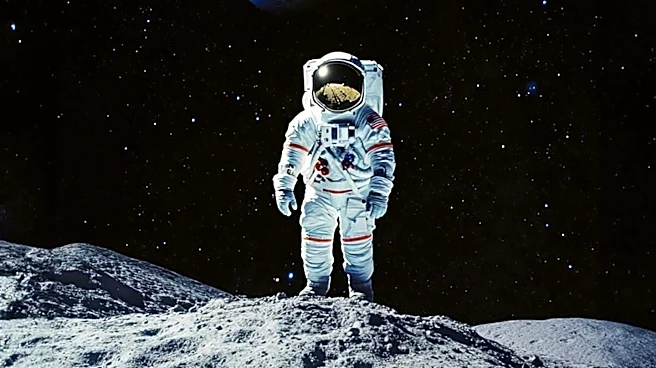
NASA is exploring a new initiative called EARENDIL, which stands for Extended Astronaut Radioisotope-EVA in Nighttime and Deep-space Icy Landscapes. This project addresses the significant challenge of extreme cold in permanently shadowed regions (PSRs)
and during the two-week lunar night on the Moon. These conditions pose severe thermal constraints on astronauts, affecting mission flexibility and safety. The EARENDIL proposal aims to integrate compact americium-241 (Am-241) radioisotope heat sources into extravehicular activity (EVA) suits. This integration would provide astronauts with continuous warmth, independent of external power sources, enhancing their ability to conduct extended surface operations in these harsh environments. The initiative is part of a Phase I study that will assess the technical and safety feasibility of this concept through thermal modeling, health physics assessment, and systems integration analysis.
Why It's Important?
The EARENDIL initiative is crucial for advancing NASA's lunar exploration goals, particularly under the Artemis program, which aims to establish a sustainable human presence on the Moon. By enabling astronauts to operate and survive through the lunar night, EARENDIL addresses a critical technology gap identified by NASA's Space Technology Mission Directorate. This capability not only enhances crew safety during potential habitat power failures but also reduces reliance on heavy battery systems. Furthermore, it opens up new scientific and resource utilization opportunities in previously inaccessible regions of the Moon. The successful implementation of EARENDIL could redefine thermal management in human spaceflight, offering a mass- and power-efficient solution to one of the most significant constraints on lunar exploration.
What's Next?
If the EARENDIL concept proves feasible, it could significantly impact future lunar missions by extending the operational range and duration of EVAs into PSRs and nighttime environments. This would support NASA's broader ambitions for sustainable exploration architectures on the Moon and Mars. The initiative could also inform future designs for resilience and redundancy in astronaut systems, contributing to human survival in extreme extraterrestrial environments. As the project progresses, NASA will likely continue to refine the technology and assess its integration with existing EVA suit architectures, potentially leading to new standards in space exploration gear.
Beyond the Headlines
The EARENDIL initiative represents a novel application of space nuclear technology, specifically in wearable radioisotope thermal systems for astronaut life support. This approach could have broader implications for the integration of nuclear technologies into human spaceflight systems, advancing the understanding of how these technologies can enhance resilience and redundancy in extreme environments. Additionally, the project highlights the importance of interdisciplinary collaboration in addressing complex challenges in space exploration, combining expertise in thermal modeling, health physics, and systems integration.