
What's Happening?
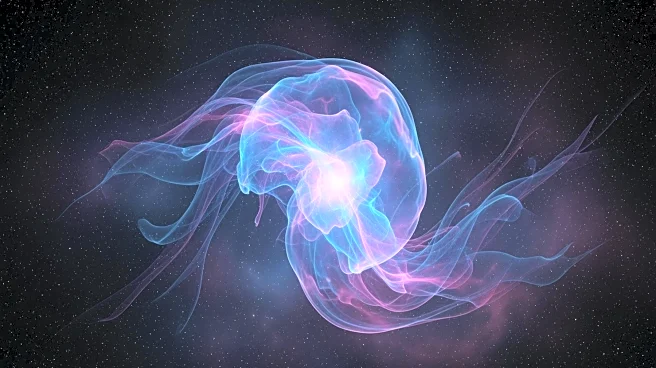
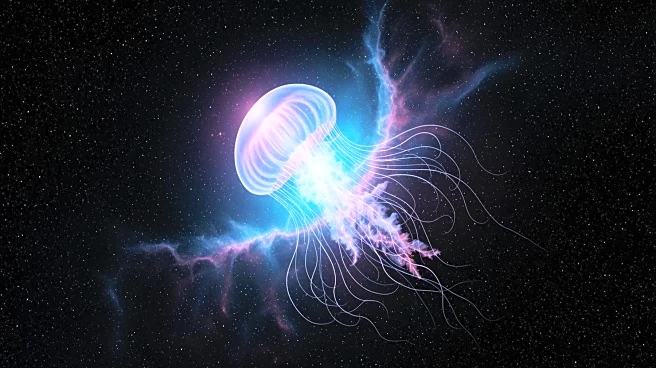
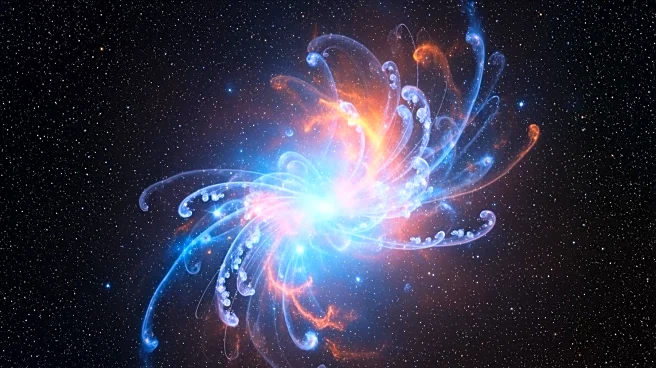
Astrophotographer Ogetay Kayali has captured a remarkable image of the Jellyfish Nebula, also known as IC 443, located 5,000 light-years from Earth in the constellation Gemini. This nebula is a supernova remnant, formed from the debris of a massive star
that exploded. The image showcases the nebula's intricate structure, with its luminous shell and dense filaments of interstellar dust and gas. The nebula's appearance has been likened to both a jellyfish and a human brain, depending on the viewer's perspective. The photograph was taken over 17 hours using a William Optics Redcat 51 III WFID telescope and a ZWO ASI2600MM astronomy camera, capturing the nebula's interaction with its surrounding environment.
Why It's Important?
The image of the Jellyfish Nebula provides valuable insights into the life cycle of stars and the dynamic processes that occur in the universe. Supernova remnants like IC 443 are crucial for understanding the distribution of elements in space, as they release heavy elements into the interstellar medium, contributing to the formation of new stars and planets. The detailed observation of such phenomena helps astronomers study the effects of supernovae on their surroundings, including the creation of shock fronts and the interaction with interstellar gas. This contributes to a broader understanding of cosmic evolution and the complex mechanisms driving the universe.
What's Next?
Further studies and observations of the Jellyfish Nebula and similar supernova remnants are expected to continue, utilizing advanced telescopes and imaging technology. These efforts aim to deepen our understanding of the physical processes involved in supernova explosions and their aftermath. Additionally, the ongoing development of astrophotography techniques will likely lead to more detailed and comprehensive images of such cosmic phenomena, enhancing both scientific research and public interest in astronomy.
Beyond the Headlines
The Jellyfish Nebula's dual resemblance to a jellyfish and a human brain highlights the intersection of art and science in astrophotography. This creative perspective not only engages the public's imagination but also emphasizes the beauty and complexity of the universe. The ability to capture and interpret such images fosters a greater appreciation for the natural world and encourages further exploration and discovery in the field of astronomy.